
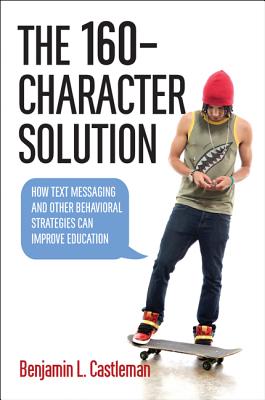
The 160-Character Solution: How Text Messaging and Other Behavioral Strategies Can Improve Education
| AUTHOR | Castleman, Benjamin L. |
| PUBLISHER | Johns Hopkins University Press (11/15/2015) |
| PRODUCT TYPE | Hardcover (Hardcover) |
A fascinating study that brings the power of behavioral economics to how schools work, how students learn, and how we can help them succeed.
For decades schools have invested substantial resources in boosting educational outcomes for disadvantaged students, but those investments have not always generated positive outcomes. Although many communities have expanded school choice, for example, families often choose to keep their children in failing schools. And while the federal government has increased the size of Pell Grants, many college-bound students who would be eligible for aid never apply. Then there is the troubling trend of "summer melt," in which up to 40 percent of high school graduates who have been accepted to college, mostly from underserved communities, fail to show up for the fall semester.
In The 160-Character Solution, Benjamin L. Castleman shows how insights from behavioral economics--the study of how social, cognitive, and emotional factors affect our decisions--can be leveraged to help students complete assignments, perform to their full potential on tests, and choose schools and colleges where they are well positioned for success. By employing behavioral strategies or "nudges," Castleman shows, administrators, teachers, and parents can dramatically improve educational outcomes from preschool to college.
Castleman applies the science of decision making to explain why inequalities persist at various stages in education and to identify innovative solutions to improve students' academic achievement and attainment. By focusing on behavioral changes, Castleman demonstrates that small changes in how we ask questions, design applications, and tailor reminders can have remarkable impacts on student and school success.
A fascinating study that brings the power of behavioral economics to how schools work, how students learn, and how we can help them succeed.
For decades schools have invested substantial resources in boosting educational outcomes for disadvantaged students, but those investments have not always generated positive outcomes. Although many communities have expanded school choice, for example, families often choose to keep their children in failing schools. And while the federal government has increased the size of Pell Grants, many college-bound students who would be eligible for aid never apply. Then there is the troubling trend of "summer melt," in which up to 40 percent of high school graduates who have been accepted to college, mostly from underserved communities, fail to show up for the fall semester.
In The 160-Character Solution, Benjamin L. Castleman shows how insights from behavioral economics--the study of how social, cognitive, and emotional factors affect our decisions--can be leveraged to help students complete assignments, perform to their full potential on tests, and choose schools and colleges where they are well positioned for success. By employing behavioral strategies or "nudges," Castleman shows, administrators, teachers, and parents can dramatically improve educational outcomes from preschool to college.
Castleman applies the science of decision making to explain why inequalities persist at various stages in education and to identify innovative solutions to improve students' academic achievement and attainment. By focusing on behavioral changes, Castleman demonstrates that small changes in how we ask questions, design applications, and tailor reminders can have remarkable impacts on student and school success.