
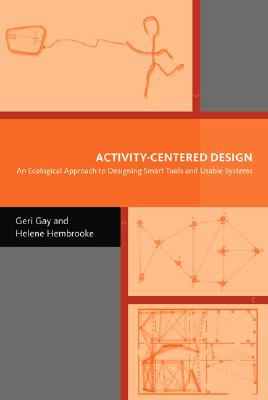
Activity-Centered Design: An Ecological Approach to Designing Smart Tools and Usable Systems
| AUTHOR | Nardi, Bonnie A.; Gay, Geraldine; Hembrooke, Helene |
| PUBLISHER | MIT Press (02/06/2004) |
| PRODUCT TYPE | Hardcover (Hardcover) |
An examination of the shift to context-based human-computer interaction design practice, illuminated by the concepts of Activity Theory and related methods.
The shift in the practice of human-computer interaction (HCI) Design from user-centered to context-based design marks a significant change in focus. With context-based design, designers start not with a preconceived idea of what users should do, but with an understanding of what users actually do. Context-based design focuses on the situation in which the technology will be used--the activities relating to it and their social contexts. Designers must also realize that introduction of the technology itself changes the situation; in order to design workable systems, the design process must become flexible and adaptive. In Activity-Centered Design, Geri Gay and Helene Hembrooke argue that it is time to develop new models for HCI design that support not only research and development but also investigations into the context and motivation of user behavior.Gay and Hembrooke examine the ongoing interaction of computer systems use, design practice, and design evaluation, using the concepts of activity theory and related methods as a theoretical framework. Among the topics they discuss are the reciprocal relationship between the tool and the task, how activities shape the requirements of particular tools and how the application of the tools begins to reshape the activity; differing needs and expectations of participants when new technology is introduced, examining in particular the integration of wireless handheld devices into museums and learning environments; and the effect of the layout of the computing space on movement, function, and social interaction. Gay and Hembrooke then apply their findings on the use of technology in everyday contexts to inform future HCI design practice.
An examination of the shift to context-based human-computer interaction design practice, illuminated by the concepts of Activity Theory and related methods.
The shift in the practice of human-computer interaction (HCI) Design from user-centered to context-based design marks a significant change in focus. With context-based design, designers start not with a preconceived idea of what users should do, but with an understanding of what users actually do. Context-based design focuses on the situation in which the technology will be used--the activities relating to it and their social contexts. Designers must also realize that introduction of the technology itself changes the situation; in order to design workable systems, the design process must become flexible and adaptive. In Activity-Centered Design, Geri Gay and Helene Hembrooke argue that it is time to develop new models for HCI design that support not only research and development but also investigations into the context and motivation of user behavior.Gay and Hembrooke examine the ongoing interaction of computer systems use, design practice, and design evaluation, using the concepts of activity theory and related methods as a theoretical framework. Among the topics they discuss are the reciprocal relationship between the tool and the task, how activities shape the requirements of particular tools and how the application of the tools begins to reshape the activity; differing needs and expectations of participants when new technology is introduced, examining in particular the integration of wireless handheld devices into museums and learning environments; and the effect of the layout of the computing space on movement, function, and social interaction. Gay and Hembrooke then apply their findings on the use of technology in everyday contexts to inform future HCI design practice.