
Back to Search

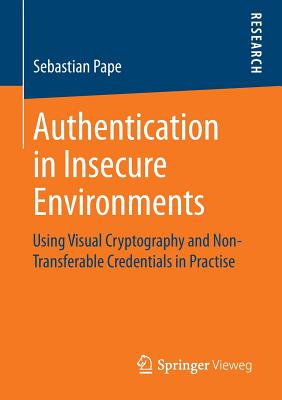
Authentication in Insecure Environments: Using Visual Cryptography and Non-Transferable Credentials in Practise

AUTHOR Pape, Sebastian
PUBLISHER Springer Vieweg (09/16/2014)
PRODUCT TYPE Paperback (Paperback)

Description
Sebastian Pape discusses two different scenarios for authentication. On the one hand, users cannot trust their devices and nevertheless want to be able to do secure authentication. On the other hand, users may not want to be tracked while their service provider does not want them to share their credentials. Many users may not be able to determine whether their device is trustworthy, i.e. it might contain malware. One solution is to use visual cryptography for authentication. The author generalizes this concept to human decipherable encryption schemes and establishes a relationship to CAPTCHAS. He proposes a new security model and presents the first visual encryption scheme which makes use of noise to complicate the adversary's task. To prevent service providers from keeping their users under surveillance, anonymous credentials may be used. However, sometimes it is desirable to prevent the users from sharing their credentials. The author compares existing approaches based on non-transferable anonymous credentials and proposes an approach which combines biometrics and smartcards.
Show More
Product Format
Product Details
ISBN-13: 9783658071158
ISBN-10: 365807115X
Binding: Paperback or Softback (Trade Paperback (Us))
Content Language: English
More Product Details
Page Count: 362
Carton Quantity: 20
Product Dimensions: 5.83 x 0.78 x 8.27 inches
Weight: 1.00 pound(s)
Feature Codes: Illustrated
Country of Origin: NL
Subject Information
BISAC Categories
Computers | Information Theory
Computers | Internet - General
Computers | Data Science - General
Dewey Decimal: 005.7
Descriptions, Reviews, Etc.
jacket back

Sebastian Pape discusses two different scenarios for authentication. On the one hand, users cannot trust their devices and nevertheless want to be able to do secure authentication. On the other hand, users may not want to be tracked while their service provider does not want them to share their credentials.

Many users may not be able to determine whether their device is trustworthy, i.e. it might contain malware. One solution is to use visual cryptography for authentication. The author generalizes this concept to human decipherable encryption schemes and establishes a relationship to CAPTCHAS. He proposes a new security model and presents the first visual encryption scheme which makes use of noise to complicate the adversary's task.

To prevent service providers from keeping their users under surveillance, anonymous credentials may be used. However, sometimes it is desirable to prevent the users from sharing their credentials. The author compares existing approaches basedon non-transferable anonymous credentials and proposes an approach which combines biometrics and smartcards.

Contents

  • Human Decipherable Encryption Schemes
  • Visual Cryptography
  • Non-Transferable Anonymous Credentials
  • Authentication

Target Groups

  • Teachers, students and practitioners in the fields of cryptography and IT security

About the Author

Dr. Sebastian Pape is postdoctoral researcher at the Chair of Software Engineering at Technical University Dortmund.

Show More
publisher marketing
Sebastian Pape discusses two different scenarios for authentication. On the one hand, users cannot trust their devices and nevertheless want to be able to do secure authentication. On the other hand, users may not want to be tracked while their service provider does not want them to share their credentials. Many users may not be able to determine whether their device is trustworthy, i.e. it might contain malware. One solution is to use visual cryptography for authentication. The author generalizes this concept to human decipherable encryption schemes and establishes a relationship to CAPTCHAS. He proposes a new security model and presents the first visual encryption scheme which makes use of noise to complicate the adversary's task. To prevent service providers from keeping their users under surveillance, anonymous credentials may be used. However, sometimes it is desirable to prevent the users from sharing their credentials. The author compares existing approaches based on non-transferable anonymous credentials and proposes an approach which combines biometrics and smartcards.
Show More
List Price $54.99
Your Price  $54.44
Paperback