
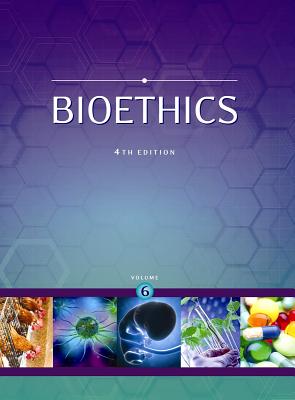
Bioethics: 6 Volume Set
| PUBLISHER | MacMillan Reference Library (05/12/2014) |
| PRODUCT TYPE | Hardcover (Hardcover) |
Should patents on living organisms be permitted?
When does consciousness begin in human being?
Are there circumstances under which people should be sterilized?
Questions such as these and others are the basis of assignments, debate topics, and life and death decisions people face everyday. They are aspects of a broad and dynamic field called Bioethics. Bioethics is the where ethics right and wrong intersect with biology, medicine, biotechnology, politics, law, religion and philosophy. It encompasses issues of profound importance to students, faculty and laypersons. Yet balanced, objective information free from business, political or religious agendas is hard to come by.
The encyclopedia used a basic conceptual framework involving 3 clear steps to explore, understand, and address key issues and questions; these are
Identifying applicable moral principles, ideals, or standards;
Assessing current practice or behavior in light of principles;
And suggesting policies or procedures to bring practice into line with principles.
With its initial publication in 1978, Bioethics became the first reference to focus solely on a then burgeoning field, in effect helping to define the discipline. Both the first and second (1995) editions won the Dartmouth Medal, and the set remains the standard reference on bioethics for teachers, students, and those in related fields of health care, philosophy, environmentalism, law, and religious studies. The fourth edition offers hundreds of revisions or addenda to entries from previous editions as well as over 100 new or rewritten entries on topics such as key cases in bioethics, the human biome, genetically modified foods, emergency preparedness and response, social justice, sustainability, chemical warfare and torture, among many others. Revised articles will explain the events as well as legislation changes of the past decade. The work is also being expanded to include views of nations and cultures other than the United States on such issues as abortion, medical triage, social responsibility, access to health care, stem cell research, etc.
In nearly 500 entries averaging 4000 words, key concepts and issues in bioethics are explained.
Many subjects--such as abortion, animal rights, genetic testing--are discussed in terms of various perspectives: religious, ethical, policy/law, etc.
Entries will have bibliographies and cross references to other articles; also included will be tables/charts/graphs, a topical outline, an annotated bibliography, an annotated list of legal cases, an annotated filmography, and an index."
Should patents on living organisms be permitted?
When does consciousness begin in human being?
Are there circumstances under which people should be sterilized?
Questions such as these and others are the basis of assignments, debate topics, and life and death decisions people face everyday. They are aspects of a broad and dynamic field called Bioethics. Bioethics is the where ethics right and wrong intersect with biology, medicine, biotechnology, politics, law, religion and philosophy. It encompasses issues of profound importance to students, faculty and laypersons. Yet balanced, objective information free from business, political or religious agendas is hard to come by.
The encyclopedia used a basic conceptual framework involving 3 clear steps to explore, understand, and address key issues and questions; these are
Identifying applicable moral principles, ideals, or standards;
Assessing current practice or behavior in light of principles;
And suggesting policies or procedures to bring practice into line with principles.
With its initial publication in 1978, Bioethics became the first reference to focus solely on a then burgeoning field, in effect helping to define the discipline. Both the first and second (1995) editions won the Dartmouth Medal, and the set remains the standard reference on bioethics for teachers, students, and those in related fields of health care, philosophy, environmentalism, law, and religious studies. The fourth edition offers hundreds of revisions or addenda to entries from previous editions as well as over 100 new or rewritten entries on topics such as key cases in bioethics, the human biome, genetically modified foods, emergency preparedness and response, social justice, sustainability, chemical warfare and torture, among many others. Revised articles will explain the events as well as legislation changes of the past decade. The work is also being expanded to include views of nations and cultures other than the United States on such issues as abortion, medical triage, social responsibility, access to health care, stem cell research, etc.
In nearly 500 entries averaging 4000 words, key concepts and issues in bioethics are explained.
Many subjects--such as abortion, animal rights, genetic testing--are discussed in terms of various perspectives: religious, ethical, policy/law, etc.
Entries will have bibliographies and cross references to other articles; also included will be tables/charts/graphs, a topical outline, an annotated bibliography, an annotated list of legal cases, an annotated filmography, and an index."