
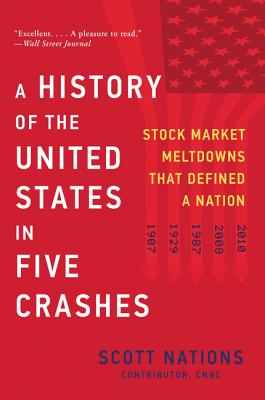
A History of the United States in Five Crashes: Stock Market Meltdowns That Defined a Nation
| AUTHOR | Nations, Scott |
| PUBLISHER | William Morrow & Company (06/05/2018) |
| PRODUCT TYPE | Paperback (Paperback) |
"Excellent." -- Wall Street Journal
"My hands-down financial book of the year. . . . An incredibly rich mine of market history. . . . Enlightening. . . . Meticulous. . . . Definitive. . . . Absolutely first class." -- Financial Advisor Magazine
Clearly and compellingly illustrates the connections between major financial collapses, and examines the solid, clear-cut lessons they offer for preventing the next one
The stories behind the biggest stock market crashes in US history are rife with drama, human folly, and heroic rescues. Taken together, the pendulum swings between the larger story of a nation reaching enormous heights of financial power while experiencing precipitous dips that devastate a market where millions of Americans invest their savings, and on which they depend for their retirement, children's education, and long-term financial well-being. CNBC contributor, longtime stock trader, and financial engineer Scott Nations vividly shows how each of these major crashes played a role in America's political and cultural fabric, each providing painful lessons that have strengthened us and helped us to build the nation we know today.
The Big Five financial crises covered:
The Panic of 1907: When the Knickerbocker Trust Company failed, after a brazen attempt to manipulate the stock market led to a disastrous run on the banks, the Dow lost nearly half its value in weeks. Only billionaire J.P. Morgan was able to save the stock market.
Black Tuesday (1929): As the newly created Federal Reserve System repeatedly adjusted interest rates in all the wrong ways, investment trusts, the darlings of that decade, became the catalyst that caused the bubble to burst, and the Dow fell dramatically, leading swiftly to the Great Depression.
Black Monday (1987): When "portfolio insurance," a new tool meant to protect investments, instead led to increased losses, and corporate raiders drove stock prices above their real values, the Dow dropped an astonishing 22.6 percent in one day.
The Great Recession (2008): As homeowners began defaulting on mortgages, investment portfolios that contained them collapsed, bringing the nation's largest banks, much of the economy, and the stock market down with them.
The Flash Crash (2010): When one investment manager, using a runaway computer algorithm that was dangerously unstable and poorly understood, reacted to the economic turmoil in Greece, the stock market took an unprecedentedly sudden plunge, with the Dow shedding 998.5 points (roughly a trillion dollars in valuation) in just minutes.
"Excellent." -- Wall Street Journal
"My hands-down financial book of the year. . . . An incredibly rich mine of market history. . . . Enlightening. . . . Meticulous. . . . Definitive. . . . Absolutely first class." -- Financial Advisor Magazine
Clearly and compellingly illustrates the connections between major financial collapses, and examines the solid, clear-cut lessons they offer for preventing the next one
The stories behind the biggest stock market crashes in US history are rife with drama, human folly, and heroic rescues. Taken together, the pendulum swings between the larger story of a nation reaching enormous heights of financial power while experiencing precipitous dips that devastate a market where millions of Americans invest their savings, and on which they depend for their retirement, children's education, and long-term financial well-being. CNBC contributor, longtime stock trader, and financial engineer Scott Nations vividly shows how each of these major crashes played a role in America's political and cultural fabric, each providing painful lessons that have strengthened us and helped us to build the nation we know today.
The Big Five financial crises covered:
The Panic of 1907: When the Knickerbocker Trust Company failed, after a brazen attempt to manipulate the stock market led to a disastrous run on the banks, the Dow lost nearly half its value in weeks. Only billionaire J.P. Morgan was able to save the stock market.
Black Tuesday (1929): As the newly created Federal Reserve System repeatedly adjusted interest rates in all the wrong ways, investment trusts, the darlings of that decade, became the catalyst that caused the bubble to burst, and the Dow fell dramatically, leading swiftly to the Great Depression.
Black Monday (1987): When "portfolio insurance," a new tool meant to protect investments, instead led to increased losses, and corporate raiders drove stock prices above their real values, the Dow dropped an astonishing 22.6 percent in one day.
The Great Recession (2008): As homeowners began defaulting on mortgages, investment portfolios that contained them collapsed, bringing the nation's largest banks, much of the economy, and the stock market down with them.
The Flash Crash (2010): When one investment manager, using a runaway computer algorithm that was dangerously unstable and poorly understood, reacted to the economic turmoil in Greece, the stock market took an unprecedentedly sudden plunge, with the Dow shedding 998.5 points (roughly a trillion dollars in valuation) in just minutes.