
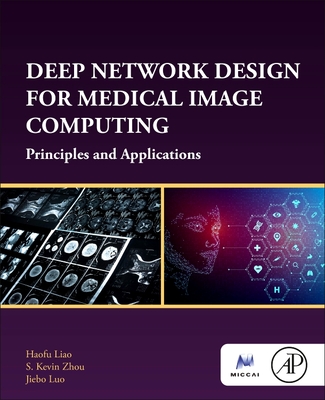
Deep Network Design for Medical Image Computing: Principles and Applications
| AUTHOR | Zhou, S. Kevin; Zhou, Kevin; Luo, Jiebo et al. |
| PUBLISHER | Academic Press (08/30/2022) |
| PRODUCT TYPE | Paperback (Paperback) |
Deep Network Design for Medical Image Computing: Principles and Applications covers a range of MIC tasks and discusses design principles of these tasks for deep learning approaches in medicine. These include skin disease classification, vertebrae identification and localization, cardiac ultrasound image segmentation, 2D/3D medical image registration for intervention, metal artifact reduction, sparse-view artifact reduction, etc. For each topic, the book provides a deep learning-based solution that takes into account the medical or biological aspect of the problem and how the solution addresses a variety of important questions surrounding architecture, the design of deep learning techniques, when to introduce adversarial learning, and more.
This book will help graduate students and researchers develop a better understanding of the deep learning design principles for MIC and to apply them to their medical problems.
Deep Network Design for Medical Image Computing: Principles and Applications covers a range of MIC tasks and discusses design principles of these tasks for deep learning approaches in medicine. These include skin disease classification, vertebrae identification and localization, cardiac ultrasound image segmentation, 2D/3D medical image registration for intervention, metal artifact reduction, sparse-view artifact reduction, etc. For each topic, the book provides a deep learning-based solution that takes into account the medical or biological aspect of the problem and how the solution addresses a variety of important questions surrounding architecture, the design of deep learning techniques, when to introduce adversarial learning, and more.
This book will help graduate students and researchers develop a better understanding of the deep learning design principles for MIC and to apply them to their medical problems.