
Available options are listed below:
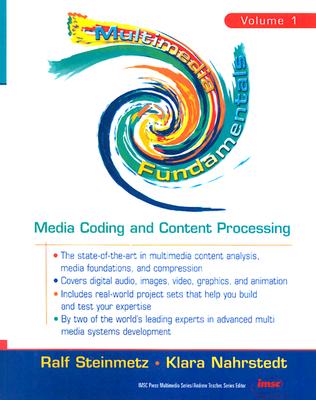
Multimedia Fundamentals, Volume 1: Media Coding and Content Processing (Out of print)
| AUTHOR | Steinmetz, Ralf; Nahrstedt, Klara |
| PUBLISHER | Pearson (01/16/2002) |
| PRODUCT TYPE | Paperback (Paperback) |
From DVDs to the Internet, media coding and content processing are central to the effective delivery of high-quality multimedia. In this book, two of the field's leading experts introduce today's state-of-the-art -- presenting realistic examples and projects designed to help implementers create multimedia systems with unprecedented performance.KEY TOPICS: The authors introduce the fundamental characteristics and properties of digital audio, images, video, graphics and animation, giving multimedia system designers and application developer the key information they need to build advanced multimedia systems and applications. They reflect the latest approaches to content analysis and compression, showing how to take advantage of the characteristics of images, video or speech to specify and compress multimedia content with maximum efficiency. They present comprehensive coverage of system and end-user issues that cannot be found elsewhere, and present hands-on projects designed to help professionals rapidly deepen their expertise.MARKET: For every professional involved in implementing or researching state-of-the-art multimedia systems and applications, including multimedia and communications engineers, software developers, streaming media specialists, and technical project managers.
- The state-of-the-art in multimedia content analysis, media foundations, and compression
- Covers digital audio, images, video, graphics, and animation
- Includes real-world project sets that help you build and test your expertise
- By two of the world's leading experts in advanced multimedia systems development
- Generic characteristics of multimedia and data streams, and their impact on multimedia system design
- Essential audio concepts and representation techniques: sound perception, psychoacoustics, music, MIDI, Speech signals, and related I/O and transmission issues
- Graphics and image characteristics: image formats, analysis, synthesis, reconstruction, and output
- Video signals, television formats, digitization, and computer-based animation issues
- Fundamental compression methods: run-length, Huffman, and subband coding
- Multimedia compression standards: JPEG, H.232, and various MPEG techniques
- Optical storage technologies and techniques: CD-DA, CD-ROM, DVD, and beyond
- Content processing techniques: Image analysis, video processing, cut detection, and audio analysis
From DVDs to the Internet, media coding and content processing are central to the effective delivery of high-quality multimedia. In this book, two of the field's leading experts introduce today's state-of-the-art -- presenting realistic examples and projects designed to help implementers create multimedia systems with unprecedented performance.KEY TOPICS: The authors introduce the fundamental characteristics and properties of digital audio, images, video, graphics and animation, giving multimedia system designers and application developer the key information they need to build advanced multimedia systems and applications. They reflect the latest approaches to content analysis and compression, showing how to take advantage of the characteristics of images, video or speech to specify and compress multimedia content with maximum efficiency. They present comprehensive coverage of system and end-user issues that cannot be found elsewhere, and present hands-on projects designed to help professionals rapidly deepen their expertise.MARKET: For every professional involved in implementing or researching state-of-the-art multimedia systems and applications, including multimedia and communications engineers, software developers, streaming media specialists, and technical project managers.
Klaus Wehrle is leading the junior research group on Protocol-Engineering and Distributed Systems at Wilhelm-Schickard-Institute of Computer Science at University of TA1/4bingen (Germany). In July 2002 he received his PhD degree (with honors) for his dissertation on flexible and scalable quality-of-service mechanisms for the next generation Internet, which was awarded with the 2002 Doctoral Dissertation Award of SA1/4dwestmetall Association and the 2002 FZI Doctoral Dissertation Award (German Research Center for Information Technologie, FZI). In August 2002 he joined the ICIR networking group at the International Computer Science Institute (ICSI) as a postdoctoral fellow in the area of Peer-to-Peer networking and overlay networks. In September 2003 he set up an independant junior research group in the area of Protocol-Engineering and Distributed Systems at University of TA1/4bingen. His research activities arefocused on (but not limited to) engineering of networking protocols, implementation techniques for protocols, formal description techniques for protocols, quality of service, multicast, network simulation, peer-to-peer-networking as well as all operating system issues of networking.