
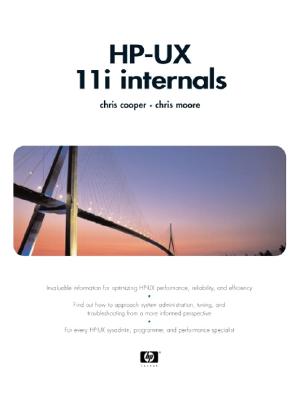
HP-UX 11i Internals
| AUTHOR | Moore, Chris; Cooper, Chris |
| PUBLISHER | Prentice Hall (01/22/2004) |
| PRODUCT TYPE | Paperback (Paperback) |
HP-UX Internals introduces readers to the "under the hood" aspects of the HP-UX operating system. The book illustrates the kernel data structures and algorithms used to provide process/thread scheduling, I/O control and system resource management. Both hardware dependent and hardware independent data structures are examined and explained. The topics covered help readers approach system administration, tuning and troubleshooting from a more informed perspective, and challenge them to make more effective use of their HP-UX systems. The material is focused on the HP-UX 11i (version 1.0) release of the HP-UX operating system, but includes some historic aspects of its development to establish and understanding of its current incarnation.
HP-UX 11i Internals
Chris CooperChris Moore
- Invaluable information for optimizing HP-UX performance, reliability, and efficiency
- Find out how to approach system administration, tuning, and troubleshooting from a more informed perspective
- For every HP-UX sysadmin, programmer, and performance specialist
HP Professional Books
HP-UX 11i Internals
HP-UX under the hood: practical insight for optimization and troubleshooting
To maximize the performance, efficiency, and reliability of your HP-UX sysem, you need to know what's going on under the hood. HP-UX 11i Internals goes beyond generic UNIX internals, showing exactly how HP-UX works in PA-RISC environments.
HP experts Cooper and Moore systematically illuminate HP-UX kernel data structures and algorithms for memory management, process and thread scheduling, I/O control, files and file systems, resource management, and more. They focus on HP-UX 11i, while also offering valuable insight for those using earlier versions.
- PA-RISC architecture: register set, virtual memory, key instructions, and procedure calling conventions
- HP-UX kernel organization: hardware-dependent and independent data structures
- Process and thread management: proc tables, memory management, scheduling, and the complete process/thread lifecycle
- System-wide memory resources: allocation and mapping to physical memory
- HP-UX paging and swapping
- Files and filesystems: traditional UNIX filesystems, HFS, VFS, and dynamic buffer cache
- I/O and device management: addressing, DMA, interrupts, device files, I/O configuration, device driver assignments, and I/O request pathways
- Logical Volume Management (LVM): abstracting physical disks from the disk I/O system
- HP-UX multiprocessing: challenges, data structures, and interfaces
- Kernel communication services: semaphores, message queues, shared memory, signals, and the kernel "callout" system
- Signaling in complex threaded environments
- System initialization, from vmunix to init: running HP-UX on diverse platforms
Whether you administer HP-UX, tune it, troubleshoot it, or write kernel modules for it, you'll find HP-UX 11i Internals indispensable.
U.S. $59.99 Canada $90.99
PRENTICE HALL
Upper Saddle River, NJ 07458
www.phptr.com
Hewlett-Packard(R) Professional Books
A Prentice Hall Title
www.hp.com/hpbooks
ISBN: 0-13-032861-8
HP-UX Internals introduces readers to the "under the hood" aspects of the HP-UX operating system. The book illustrates the kernel data structures and algorithms used to provide process/thread scheduling, I/O control and system resource management. Both hardware dependent and hardware independent data structures are examined and explained. The topics covered help readers approach system administration, tuning and troubleshooting from a more informed perspective, and challenge them to make more effective use of their HP-UX systems. The material is focused on the HP-UX 11i (version 1.0) release of the HP-UX operating system, but includes some historic aspects of its development to establish and understanding of its current incarnation.