
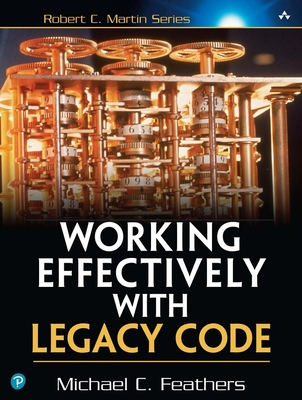
Working Effectively with Legacy Code
| AUTHOR | Feathers, Michael |
| PUBLISHER | Pearson (09/01/2004) |
| PRODUCT TYPE | Paperback (Paperback) |
This book provides programmers with the ability to cost-effectively handle common legacy code problems without having to go through the hugely expensive task of rewriting all existing code. It describes a series of practical strategies that developers can employ to bring their existing software applications under control. The author provides useful guidance about how to use these strategies when refactoring or making functional changes to codebases.
One of the book's key points is that it teaches developers to write tests that can be used to ensure they are not unintentionally changing the application as they optimize it. Examples are provided in Java, C++, and C#, and the book assumes that the reader has some knowledge of UML notation. Strategies using UML and code in C++ and Java are emphasized, while language-independent advice is delivered in sidebars and appendices for language-specific users.
This book provides programmers with the ability to cost-effectively handle common legacy code problems without having to go through the hugely expensive task of rewriting all existing code. It describes a series of practical strategies that developers can employ to bring their existing software applications under control. The author provides useful guidance about how to use these strategies when refactoring or making functional changes to codebases.
One of the book's key points is that it teaches developers to write tests that can be used to ensure they are not unintentionally changing the application as they optimize it. Examples are provided in Java, C++, and C#, and the book assumes that the reader has some knowledge of UML notation. Strategies using UML and code in C++ and Java are emphasized, while language-independent advice is delivered in sidebars and appendices for language-specific users.
(c) Copyright Pearson Education. All rights reserved.