
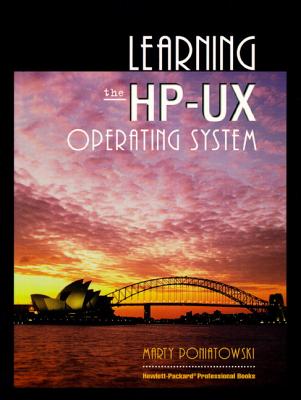
Available options are listed below:
Learning the HP-UX Operating System (Out of print)
| AUTHOR | Hewlett-Packard Professional Books; Poniatowski, Marty |
| PUBLISHER | Prentice Hall (07/28/1996) |
| PRODUCT TYPE | Paperback (Paperback) |
A comprehensive introduction to HP-UX for new users and system administrators. The book explains how to start an HP-UX session, and what happens when you do. It provides clear, detailed coverage of the HP-UX f ilesystem, and working with files. Readers will learn about HP's Visual User Environment (VUE) and the Common Desktop Environment (CDE) that HP shares with many other leading UNIX system providers. The book also covers UNIX shells, shell programming, and HP-UX programming tools. For application developers familiar with other operating systems, application users working on HP-UX workstations, and new HP-UX system administrators familiar with UNIX but not HP-UX.
25853-3
HP-UX has taken off in popularity. As a result of this popularity there are many new HP-UX users. Some of these new HP-UX users have direct experience with other operating systems but have no direct experience with UNIX. Others have learned HP-UX "the hard way," by experimenting. Still others have taken an HP-UX training course but are now relying on generic UNIX books to learn HP-UX. Learning the HP-UX Operating System is for all of these users.
This book doesn't waste a lot of time with the background of UNIX and comparing various UNIX implementations. Instead, the author gets right to what you need to know to be a productive HP-UX user.
The chapters in this book contain useful information and have names such as: Login and Password; The HP-UX File System; File System Related Commands; HP-UX Tools; HP-UX Networking; and Shell Programming.
This book leaves no stone unturned. From the basics such as login and password to advanced topics such as shell programming you'll be exposed to everything you need to be quickly productive with HP-UX.
A comprehensive introduction to HP-UX for new users and system administrators. The book explains how to start an HP-UX session, and what happens when you do. It provides clear, detailed coverage of the HP-UX f ilesystem, and working with files. Readers will learn about HP's Visual User Environment (VUE) and the Common Desktop Environment (CDE) that HP shares with many other leading UNIX system providers. The book also covers UNIX shells, shell programming, and HP-UX programming tools. For application developers familiar with other operating systems, application users working on HP-UX workstations, and new HP-UX system administrators familiar with UNIX but not HP-UX.