
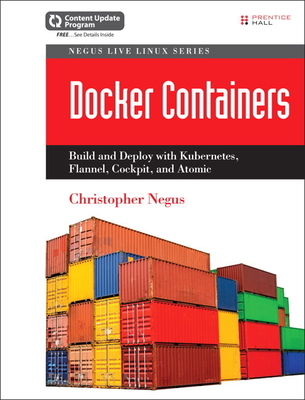
Docker Containers: Build and Deploy with Kubernetes, Flannel, Cockpit, and Atomic
| AUTHOR | Negus, Christopher |
| PUBLISHER | Pearson (12/01/2015) |
| PRODUCT TYPE | Paperback (Paperback) |
The Practical Guide to Running Docker on Linux Systems or Cloud Environments
Whether on your laptop or a remote cloud, Docker can transform how you create, test, deploy, and manage your most critical applications. In Doc ker Containers, Christopher Negus helps you master Docker containerization from the ground up.
You'll start out running a few Docker container images in Ubuntu, Fedora, RHEL, CoreOS, or Project Atomic. By the time you've finished, you'll be deploying enterprise-quality, multi-container Kubernetes setups in modern Linux and cloud environments.
Writing for system administrators, software developers, and technology enthusiasts, Negus touches on every aspect of working with Docker: setting up containerized applications, working with both individual and multiple containers, running containers in cloud environments, and developing containers.
Teaching through realistic examples of desktop applications, system services, and games, Negus guides you through building and deploying your own Dockerized applications. As you build your expertise, you'll also learn indispensable Docker best practices for building and integrating containers, managing Docker on a day-to-day basis, and much more:
- Understanding what Docker is and what you can do with it
- Installing Docker on standard Linux or specialized container operating systems such as Atomic Host and CoreOS
- Setting up a container runtime environment and private Docker Registry
- Creating, running, and investigating Docker images and containers
- Finding, pulling, saving, loading, and tagging container images
- Pulling and pushing containers between local systems and Docker Registries
- Integrating Docker containers with host networking and storage
- Building containers with the docker build command and Dockerfile files
- Minimizing space consumption and erasing unneeded containers
- Accessing special host privileges from within a container
- Orchestrating multiple containers into complex applications with Kubernetes
- Using super privileged containers in cloud environments
- Managing containers in the cloud with Cockpit
- Getting started with Docker container development
- Learning container build techniques from shared Dockerfiles
This book is part of the Pearson Content Update Program. As the technology changes, sections of this book will be updated or new sections will be added. The updates will be delivered to you via a free Web Edition of this book, which can be accessed with any Internet connection.
The Practical Guide to Running Docker on Linux Systems or Cloud Environments
Whether on your laptop or a remote cloud, Docker can transform how you create, test, deploy, and manage your most critical applications. In Doc ker Containers, Christopher Negus helps you master Docker containerization from the ground up.
You'll start out running a few Docker container images in Ubuntu, Fedora, RHEL, CoreOS, or Project Atomic. By the time you've finished, you'll be deploying enterprise-quality, multi-container Kubernetes setups in modern Linux and cloud environments.
Writing for system administrators, software developers, and technology enthusiasts, Negus touches on every aspect of working with Docker: setting up containerized applications, working with both individual and multiple containers, running containers in cloud environments, and developing containers.
Teaching through realistic examples of desktop applications, system services, and games, Negus guides you through building and deploying your own Dockerized applications. As you build your expertise, you'll also learn indispensable Docker best practices for building and integrating containers, managing Docker on a day-to-day basis, and much more:
- Understanding what Docker is and what you can do with it
- Installing Docker on standard Linux or specialized container operating systems such as Atomic Host and CoreOS
- Setting up a container runtime environment and private Docker Registry
- Creating, running, and investigating Docker images and containers
- Finding, pulling, saving, loading, and tagging container images
- Pulling and pushing containers between local systems and Docker Registries
- Integrating Docker containers with host networking and storage
- Building containers with the docker build command and Dockerfile files
- Minimizing space consumption and erasing unneeded containers
- Accessing special host privileges from within a container
- Orchestrating multiple containers into complex applications with Kubernetes
- Using super privileged containers in cloud environments
- Managing containers in the cloud with Cockpit
- Getting started with Docker container development
- Learning container build techniques from shared Dockerfiles
This book is part of the Pearson Content Update Program. As the technology changes, sections of this book will be updated or new sections will be added. The updates will be delivered to you via a free Web Edition of this book, which can be accessed with any Internet connection.
Thomas ("Tweeks") Weeks holds a BS-EET/Telecom degree from Texas A& M, has worked for several large government and IT/security contractors in the positions of Test and Integration lab coordinator and general sysadmin, sysadmin technical trainer and course developer, as well as electrical and systems engineer. He has been working with Rackspace Managed Hosting since 1999 in the roles of Sys-Admin, Corporate Technical Trainer, and has acted as liaison between customer support/security/product/engineering departments. Tweeks has also been president of the San Antonio user group, X-otic Computer Systems of San Antonio (xcssa.org) since 1996.