
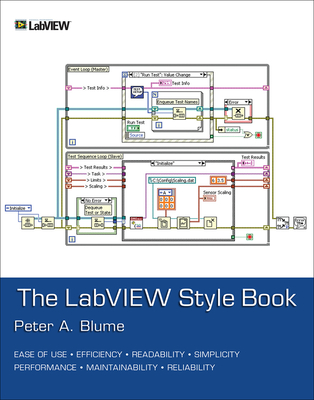
The LabVIEW Style Book
| AUTHOR | Blume, Peter; Blume, Peter A. |
| PUBLISHER | Pearson (11/21/2017) |
| PRODUCT TYPE | Paperback (Paperback) |
Description
Drawing on the experiences of a world-class LabVIEW development organization, The LabVIEW Style Book is the definitive guide to best practices in LabVIEW development. Leading LabVIEW development manager Peter A. Blume presents practical guidelines or "rules" for optimizing every facet of your applications: ease of use, efficiency, readability, simplicity, performance, maintainability, and robustness. Blume explains each style rule thoroughly, presenting realistic examples and illustrations. He even presents "nonconforming" examples that show what not to do--and why not. While the illustrations in the print book are in black and white, you can download full-color versions from the publisher web site for free. Coverage includes
Preface
Acknowledgments
About the Author
Chapter 1 The Significance of Style
Chapter 2 Prepare for Good Style
Chapter 3 Front Panel Style
Chapter 4 Block Diagram
Chapter 5 Icon and Connector
Chapter 6 Data Structures
Chapter 7 Error Handling
Chapter 8 Design Patterns
Chapter 9 Documentation
Chapter 10 Code Reviews
Appendix A Glossary
Appendix B Style Rules Summary
Index
- Significance of style: How good style improves quality and actually saves time over the full project life cycle
- Before you code: Configuring your LabVIEW environment, and organizing your files on disk and in the LabVIEW project
- LabVIEW project specifications: A specialized standard for specifying LabVIEW application requirements
- Efficient VI layout and development: front panel, block diagram, icons, and connectors
- Data structures: Choosing data types, efficient use of arrays and clusters, and special considerations with nested data structures
- Error handling strategies: Trapping and reporting errors for robust and reliable applications
- Design patterns: Standard VI architectures and application frameworks that promote good style
- Documentation: Essential rules for source code documentation and streamlining the process
- Code reviews: Enforcing a style convention using a checklist, the LabVIEW VI Analyzer Toolkit, and peer reviews
- Appendixes: Convenient glossary and style rules summary
Preface
Acknowledgments
About the Author
Chapter 1 The Significance of Style
Chapter 2 Prepare for Good Style
Chapter 3 Front Panel Style
Chapter 4 Block Diagram
Chapter 5 Icon and Connector
Chapter 6 Data Structures
Chapter 7 Error Handling
Chapter 8 Design Patterns
Chapter 9 Documentation
Chapter 10 Code Reviews
Appendix A Glossary
Appendix B Style Rules Summary
Index
Show More
Product Format
Product Details
ISBN-13:
9780134878423
ISBN-10:
0134878426
Binding:
Paperback or Softback (Trade Paperback (Us))
Content Language:
English
More Product Details
Page Count:
400
Carton Quantity:
20
Product Dimensions:
8.00 x 0.90 x 9.80 inches
Weight:
1.80 pound(s)
Feature Codes:
Price on Product,
Glossary,
Illustrated
Country of Origin:
US
Subject Information
BISAC Categories
Technology & Engineering | Mechanical
Technology & Engineering | Electrical
Technology & Engineering | Software Development & Engineering - General
Dewey Decimal:
005.438
Descriptions, Reviews, Etc.
publisher marketing
Drawing on the experiences of a world-class LabVIEW development organization, The LabVIEW Style Book is the definitive guide to best practices in LabVIEW development. Leading LabVIEW development manager Peter A. Blume presents practical guidelines or "rules" for optimizing every facet of your applications: ease of use, efficiency, readability, simplicity, performance, maintainability, and robustness. Blume explains each style rule thoroughly, presenting realistic examples and illustrations. He even presents "nonconforming" examples that show what not to do--and why not. While the illustrations in the print book are in black and white, you can download full-color versions from the publisher web site for free. Coverage includes
Preface
Acknowledgments
About the Author
Chapter 1 The Significance of Style
Chapter 2 Prepare for Good Style
Chapter 3 Front Panel Style
Chapter 4 Block Diagram
Chapter 5 Icon and Connector
Chapter 6 Data Structures
Chapter 7 Error Handling
Chapter 8 Design Patterns
Chapter 9 Documentation
Chapter 10 Code Reviews
Appendix A Glossary
Appendix B Style Rules Summary
Index
- Significance of style: How good style improves quality and actually saves time over the full project life cycle
- Before you code: Configuring your LabVIEW environment, and organizing your files on disk and in the LabVIEW project
- LabVIEW project specifications: A specialized standard for specifying LabVIEW application requirements
- Efficient VI layout and development: front panel, block diagram, icons, and connectors
- Data structures: Choosing data types, efficient use of arrays and clusters, and special considerations with nested data structures
- Error handling strategies: Trapping and reporting errors for robust and reliable applications
- Design patterns: Standard VI architectures and application frameworks that promote good style
- Documentation: Essential rules for source code documentation and streamlining the process
- Code reviews: Enforcing a style convention using a checklist, the LabVIEW VI Analyzer Toolkit, and peer reviews
- Appendixes: Convenient glossary and style rules summary
Preface
Acknowledgments
About the Author
Chapter 1 The Significance of Style
Chapter 2 Prepare for Good Style
Chapter 3 Front Panel Style
Chapter 4 Block Diagram
Chapter 5 Icon and Connector
Chapter 6 Data Structures
Chapter 7 Error Handling
Chapter 8 Design Patterns
Chapter 9 Documentation
Chapter 10 Code Reviews
Appendix A Glossary
Appendix B Style Rules Summary
Index
Show More
List Price $109.00
Your Price
$107.91