
Available options are listed below:
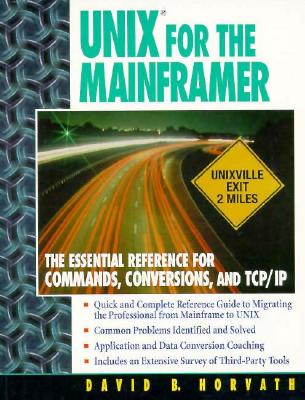
Unix for the Mainframer: The Essential Reference for Commands, Conversions, TCP/IP (Out of print)
| AUTHOR | Horvath, David B. |
| PUBLISHER | Prentice Hall (08/24/1997) |
| PRODUCT TYPE | Paperback (Paperback) |
If you know mainframes, this book will help you extend your expertise to UNIX environments. This book is a quick, complete reference guide - and a powerful tutorial - for any mainframe professional who wants to understand UNIX and TCP/IP. It provides an overview comparing and contrasting mainframe and UNIX environments from the standpoint of the mainframe professional. It introduces mainframers to UNIX data and file handling methods; shows how UNIX provides for the commands and utilities mainframe programmers are familiar with; and discusses UNIX alternatives to mainframe JCL. It covers advanced UNIX shell scripts; UNIX editors; UNIX account configuration; and third-party tools that may make mainframe developers more comfortable in the UNIX environment. The book includes detailed lists of error messages, codes, UNIX signals, hints and techniques; conversion tables for ASCII and EBCDIC; an overview of the UNIX C Shell and TCP/IP, and much more. All mainframe programmers, analysts, system analysts and consultants who need to learn UNIX. This including the rapidly increasing number of programmers in IBM environments working with mainframes as network hubs, or with IBM RS/6000 workstations.
63283-6
"I know how to do it on the mainframe, but what's the command under UNIX?"
More and more organizations are migrating to UNIX, leaving experienced programming staff frustrated by their lack of familiarity with the new environment. But mainframe skills are transferable!
Designed especially for mainframe professionals, UNIX for the Mainframer builds on existing computer knowledge to ease the technology transfer. Programmers, analysts, system analysts, database administrators, and consultants already know how computers work. This book maps that understanding to the UNIX paradigm without rehashing a lot of basic computing concepts or presuming prior familiarity with UNIX.
UNIX for the Mainframer provides a complete orientation to UNIX for users in transition. It is also an outstanding reference volume for looking up the answers to specific questions, for example:
- "What's the command for " - UNIX commands are mapped directly to the corresponding mainframe terms.
- "What's a Shell Script?" - UNIX scripting languages are explained in terms of JCL, PROC's, CLIST, and REXX.
- "How did these files get here?" - How to organize, specify, name, and retrieve UNIX files is detailed, along with full instructions for account configuration.
- "How do you edit these files?" - Popular editors are reviewed and related to ISPF commands.
- "What's going on deep down?" - A comparative history describes UNIX and mainframe operating systems and environments.
Appendices offer further resources for deciphering common error messages, converting data, comparing hardware, and accessing networks, along with general hints and suggestions for ongoing reading.
UNIX for the Mainframer is the only book that helps mainframers use their existing skills to get them up and running in the UNIX environment, fast.
"David Horvath has written an excellent introduction, tutorial, and reference for those mainframe programmers and administrators who need or want to become part of the larger computing and network world. It is solidly structured, technically sound, and more than passably readable." Robert Slade, Internet Review Project.
If you know mainframes, this book will help you extend your expertise to UNIX environments. This book is a quick, complete reference guide - and a powerful tutorial - for any mainframe professional who wants to understand UNIX and TCP/IP. It provides an overview comparing and contrasting mainframe and UNIX environments from the standpoint of the mainframe professional. It introduces mainframers to UNIX data and file handling methods; shows how UNIX provides for the commands and utilities mainframe programmers are familiar with; and discusses UNIX alternatives to mainframe JCL. It covers advanced UNIX shell scripts; UNIX editors; UNIX account configuration; and third-party tools that may make mainframe developers more comfortable in the UNIX environment. The book includes detailed lists of error messages, codes, UNIX signals, hints and techniques; conversion tables for ASCII and EBCDIC; an overview of the UNIX C Shell and TCP/IP, and much more. All mainframe programmers, analysts, system analysts and consultants who need to learn UNIX. This including the rapidly increasing number of programmers in IBM environments working with mainframes as network hubs, or with IBM RS/6000 workstations.