
Available options are listed below:
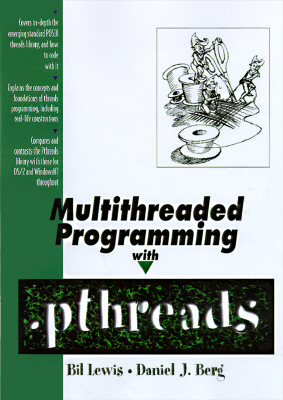
Multithreaded Programming with Pthreads (Out of print)
| AUTHOR | Sun Microsystems Press; Lewis, Bil; Berg, Daniel J. |
| PUBLISHER | Prentice Hall (12/19/1997) |
| PRODUCT TYPE | Paperback (Paperback) |
This book will give the UNIX and NT programmer a solid, basic understanding of threads -- and the powerful new POSIX Pthreads library. The book begins with an overview of the need for, and evolution of multithreading. Understand how threads are constructed, and how operating systems like Solaris(r) provide support for them. Learn the fundamentals of thread scheduling and synchronization, understanding the trade-offs involved in using synchronization variables. Learn how to dispose of (cancel) unwanted threads; and manage asynchronous events via signaling. The book includes detailed coverage of writing and compiling multithreaded programs, including sample applications, libraries, design choices, performance optimization and hardware considerations. For all experienced C, UNIX and NT programmers who need to understand the new Pthreads library.
68072-8
Based on the best-selling Threads Primer, Multithreaded Programming with Pthreads gives you a solid understanding of Posix threads: what they are, how they work, when to use them, and how to optimize them.
It retains the clarity and humor of the Primer, but includes expanded comparisons to Win32 and OS/2 implementations. Code examples tested on all of the major UNIX platforms are featured along with detailed explanations of how and why they use threads.
In addition to scheduling, synchronization, signal handling, etc., special emphasis is placed on:
- Cancellation: What does it mean to do bounded-time cancellation? What are the numerous details the programmer must deal with, and how do you avoid using cancellation at all?
- Error expeditions: What do they all mean and what should you do about them?
- Performance: How fast can a program run, and what are the limiting factors? Theoretical issues are considered and a case study for NFS is presented.
- Hardware: A number of machine designs are examined (Sun, SGI, and DEC), focusing on issues of performance, synchronization instructions, bus design, and invalidation techniques.
- Languages: The use of threads in other languages (Lisp, Eiffel, Smalltalk, etc.) is examined, with special emphasis on C++ and Java.
- References: Pointers to the newsgroup, FAQs, web pages, code examples, other books, freeware tools, and commercial products are included.
- More than anything else this is a practical book-it tells you what can and cannot be done with threads and why. In short, everything you need to know to build faster, smarter, multithreaded applications.
This book will give the UNIX and NT programmer a solid, basic understanding of threads -- and the powerful new POSIX Pthreads library. The book begins with an overview of the need for, and evolution of multithreading. Understand how threads are constructed, and how operating systems like Solaris(r) provide support for them. Learn the fundamentals of thread scheduling and synchronization, understanding the trade-offs involved in using synchronization variables. Learn how to dispose of (cancel) unwanted threads; and manage asynchronous events via signaling. The book includes detailed coverage of writing and compiling multithreaded programs, including sample applications, libraries, design choices, performance optimization and hardware considerations. For all experienced C, UNIX and NT programmers who need to understand the new Pthreads library.