
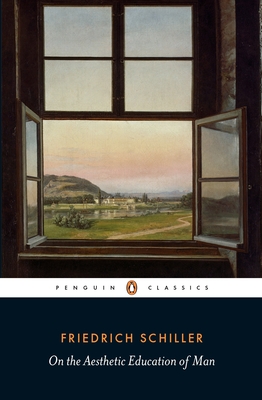
On the Aesthetic Education of Man
| AUTHOR | Schmidt, Alexander; Schmidt, Alexander; Schiller, Friedrich et al. |
| PUBLISHER | Penguin Classics (12/06/2016) |
| PRODUCT TYPE | Paperback (Paperback) |
Description
German poet and philosopher Friedrich Schiller's famous text on art, politics, and society
"The artist is certainly the child of his age, but all the worse for him if he is at the same time its pupil, even worse its minion." One of the most profound works of German philosophy, Friedrich Schiller's On the Aesthetic Education of Man examines politics, revolution, and the history of ideas in order argue that art should have a greater role in shaping society. Deeply disillusioned with the course of the French Revolution, Schiller expressed his complaints in a series of letters to a patron, an impassioned attempt to drag mankind upward from failure to greatness by placing ideas of aesthetic education at the heart of the human experience: "Our era has actually taken both wrong turnings, and has fallen prey to coarseness on the one path, lethargy and perversity on the other. Having strayed along both paths, it is beauty that can lead [us] back." One of Germany's greatest political statements from a time of revolutionary change, Schiller's arguments are as arresting, challenging, and inspiring today as when they were first written.
"The artist is certainly the child of his age, but all the worse for him if he is at the same time its pupil, even worse its minion." One of the most profound works of German philosophy, Friedrich Schiller's On the Aesthetic Education of Man examines politics, revolution, and the history of ideas in order argue that art should have a greater role in shaping society. Deeply disillusioned with the course of the French Revolution, Schiller expressed his complaints in a series of letters to a patron, an impassioned attempt to drag mankind upward from failure to greatness by placing ideas of aesthetic education at the heart of the human experience: "Our era has actually taken both wrong turnings, and has fallen prey to coarseness on the one path, lethargy and perversity on the other. Having strayed along both paths, it is beauty that can lead [us] back." One of Germany's greatest political statements from a time of revolutionary change, Schiller's arguments are as arresting, challenging, and inspiring today as when they were first written.
Show More
Product Format
Product Details
ISBN-13:
9780141396965
ISBN-10:
0141396962
Binding:
Paperback or Softback (Trade Paperback (Us))
Content Language:
English
More Product Details
Page Count:
224
Carton Quantity:
60
Product Dimensions:
5.10 x 0.50 x 7.70 inches
Weight:
0.30 pound(s)
Feature Codes:
Price on Product
Country of Origin:
GB
Subject Information
BISAC Categories
Education | Philosophy, Theory & Social Aspects
Education | Aesthetics
Education | Essays
Descriptions, Reviews, Etc.
publisher marketing
German poet and philosopher Friedrich Schiller's famous text on art, politics, and society
"The artist is certainly the child of his age, but all the worse for him if he is at the same time its pupil, even worse its minion." One of the most profound works of German philosophy, Friedrich Schiller's On the Aesthetic Education of Man examines politics, revolution, and the history of ideas in order argue that art should have a greater role in shaping society. Deeply disillusioned with the course of the French Revolution, Schiller expressed his complaints in a series of letters to a patron, an impassioned attempt to drag mankind upward from failure to greatness by placing ideas of aesthetic education at the heart of the human experience: "Our era has actually taken both wrong turnings, and has fallen prey to coarseness on the one path, lethargy and perversity on the other. Having strayed along both paths, it is beauty that can lead [us] back." One of Germany's greatest political statements from a time of revolutionary change, Schiller's arguments are as arresting, challenging, and inspiring today as when they were first written.
"The artist is certainly the child of his age, but all the worse for him if he is at the same time its pupil, even worse its minion." One of the most profound works of German philosophy, Friedrich Schiller's On the Aesthetic Education of Man examines politics, revolution, and the history of ideas in order argue that art should have a greater role in shaping society. Deeply disillusioned with the course of the French Revolution, Schiller expressed his complaints in a series of letters to a patron, an impassioned attempt to drag mankind upward from failure to greatness by placing ideas of aesthetic education at the heart of the human experience: "Our era has actually taken both wrong turnings, and has fallen prey to coarseness on the one path, lethargy and perversity on the other. Having strayed along both paths, it is beauty that can lead [us] back." One of Germany's greatest political statements from a time of revolutionary change, Schiller's arguments are as arresting, challenging, and inspiring today as when they were first written.
Show More
Introduction by:
Schmidt, Alexander
Alexander Schmidt, Dr. Phil. (2005), Friedrich-Schiller-University Jena, is Research Fellow at the Sonderforschungsbereich 482 at the University of Jena.
Show More
Notes by:
Schmidt, Alexander
Alexander Schmidt, Dr. Phil. (2005), Friedrich-Schiller-University Jena, is Research Fellow at the Sonderforschungsbereich 482 at the University of Jena.
Show More
List Price $15.00
Your Price
$14.85