
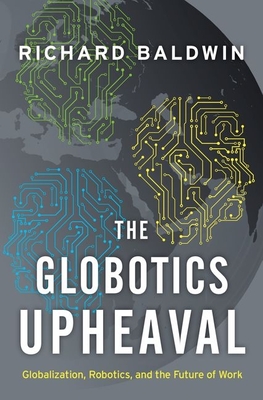
The Globotics Upheaval: Globalization, Robotics, and the Future of Work
| AUTHOR | Baldwin, Richard |
| PUBLISHER | Oxford University Press (02/08/2019) |
| PRODUCT TYPE | Hardcover (Hardcover) |
Description
At the root of inequality, unemployment, and populism are radical changes in the world economy. Digital technology is allowing talented foreigners to telecommute into our workplaces and compete for service and professional jobs. Instant machine translation is melting language barriers, so the ranks of these "tele-migrants" will soon include almost every educated person in the world. Computing power is dissolving humans' monopoly on thinking, enabling AI-trained computers to compete for many of the same white-collar jobs. The combination of globalization and robotics is creating the globotics upheaval, and it threatens the very foundations of the liberal welfare-state. Richard Baldwin, one of the world's leading globalization experts, argues that the inhuman speed of this transformation threatens to overwhelm our capacity to adapt. From computers in the office to automatic ordering systems in restaurants, we are familiar with the how digital technologies offer convenience while also eliminating jobs. Globotics will disrupt the lives of millions of white-collar workers much faster than automation, industrialization, and globalization disrupted the lives of factory workers in previous centuries. The result will be a backlash. Professional, white-collar, and service workers will agitate for a slowing of the unprecedented pace of disruption, as factory workers have done in years past. Baldwin argues that the globotics upheaval will be countered in the short run by "shelter-ism" - government policies that shelter some service jobs from tele-migrants and thinking computers. In the long run, people will work in more human jobs-activities that require real people to use the uniquely human ability of independent thought-and this will strengthen bonds in local communities. Offering effective strategies such as focusing on the social value of work, The Globotics Upheaval will help people prepare for the oncoming wave of an advanced robotic workforce.
Show More
Product Format
Product Details
ISBN-13:
9780190901769
ISBN-10:
0190901764
Binding:
Hardback or Cased Book (Sewn)
Content Language:
English
More Product Details
Page Count:
304
Carton Quantity:
24
Product Dimensions:
6.50 x 1.10 x 9.20 inches
Weight:
1.10 pound(s)
Feature Codes:
Index,
Price on Product,
Illustrated
Country of Origin:
US
Subject Information
BISAC Categories
Technology & Engineering | Robotics
Technology & Engineering | Labor - General
Technology & Engineering | Development - General
Dewey Decimal:
331.25
Library of Congress Control Number:
2018012182
Descriptions, Reviews, Etc.
publisher marketing
At the root of inequality, unemployment, and populism are radical changes in the world economy. Digital technology is allowing talented foreigners to telecommute into our workplaces and compete for service and professional jobs. Instant machine translation is melting language barriers, so the ranks of these "tele-migrants" will soon include almost every educated person in the world. Computing power is dissolving humans' monopoly on thinking, enabling AI-trained computers to compete for many of the same white-collar jobs. The combination of globalization and robotics is creating the globotics upheaval, and it threatens the very foundations of the liberal welfare-state. Richard Baldwin, one of the world's leading globalization experts, argues that the inhuman speed of this transformation threatens to overwhelm our capacity to adapt. From computers in the office to automatic ordering systems in restaurants, we are familiar with the how digital technologies offer convenience while also eliminating jobs. Globotics will disrupt the lives of millions of white-collar workers much faster than automation, industrialization, and globalization disrupted the lives of factory workers in previous centuries. The result will be a backlash. Professional, white-collar, and service workers will agitate for a slowing of the unprecedented pace of disruption, as factory workers have done in years past. Baldwin argues that the globotics upheaval will be countered in the short run by "shelter-ism" - government policies that shelter some service jobs from tele-migrants and thinking computers. In the long run, people will work in more human jobs-activities that require real people to use the uniquely human ability of independent thought-and this will strengthen bonds in local communities. Offering effective strategies such as focusing on the social value of work, The Globotics Upheaval will help people prepare for the oncoming wave of an advanced robotic workforce.
Show More
Author:
Baldwin, Richard
Patrick Low is Chief Economist (Director of Economic Research and Statistics) at the World Trade Organization.
Show More
List Price $34.99
Your Price
$34.64