
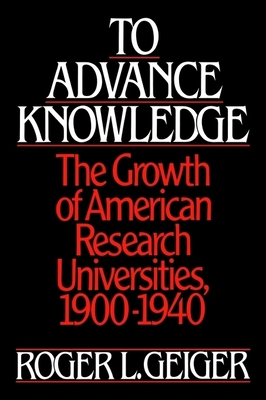
To Advance Knowledge: The Growth of American Research Universities, 1900-1940
| AUTHOR | Geiger, Roger L. |
| PUBLISHER | Oxford University Press, USA (08/12/1986) |
| PRODUCT TYPE | Hardcover (Hardcover) |
Description
American scientific supremacy was built upon the strength of our research universities. This book shows how these universities laid the foundation for the ascendancy of American science in the first half of this century, when they went from being provincial outposts of international science to being the equal of the best European centers of learning. This is a rich social history that tells much not only about the growth of American higher education but also about American intellectual life in general and the politics of scientific research in education.
How did research come to be a major function of universities? How did universities reconcile the demands of an active research program with their other institutional commitments? To answer these questions, Geiger ranges over a broad spectrum of topics, from the adoption of a selective admissions policy and the development of graduate schools to the continuing vitality of liberal arts colleges within university settings. The book includes fascinating sections on the bizarre attempt to militarize college campuses during World War I and on the backlash of the 1920's, when many major campuses became more concerned with social life than intellectual matters.
One remarkable feature of the development of research universities, Geiger points out, was that it was largely accomplished through private resources. Individual philanthropy was responsible for establishing the wealth of the private research universities, and played a key role at several state universities as well. Foundations and corporations were also highly significant in developing the institutions' research capabilities.
Geiger describes how each university resolved in its own way the conflict between the research role and other institutional commitments. The major research institutions he deals with are Harvard, Yale, Princeton, MIT, Columbia, Cornell, Pennsylvania, Stanford, the University of Chicago, Johns Hopkins, the California Institute of Technology, and the Universities of Michigan, Illinois, Wisconsin, Minnesota, and California.
How did research come to be a major function of universities? How did universities reconcile the demands of an active research program with their other institutional commitments? To answer these questions, Geiger ranges over a broad spectrum of topics, from the adoption of a selective admissions policy and the development of graduate schools to the continuing vitality of liberal arts colleges within university settings. The book includes fascinating sections on the bizarre attempt to militarize college campuses during World War I and on the backlash of the 1920's, when many major campuses became more concerned with social life than intellectual matters.
One remarkable feature of the development of research universities, Geiger points out, was that it was largely accomplished through private resources. Individual philanthropy was responsible for establishing the wealth of the private research universities, and played a key role at several state universities as well. Foundations and corporations were also highly significant in developing the institutions' research capabilities.
Geiger describes how each university resolved in its own way the conflict between the research role and other institutional commitments. The major research institutions he deals with are Harvard, Yale, Princeton, MIT, Columbia, Cornell, Pennsylvania, Stanford, the University of Chicago, Johns Hopkins, the California Institute of Technology, and the Universities of Michigan, Illinois, Wisconsin, Minnesota, and California.
Show More
Product Format
Product Details
ISBN-13:
9780195038033
ISBN-10:
0195038037
Binding:
Hardback or Cased Book (Sewn)
Content Language:
English
More Product Details
Page Count:
335
Carton Quantity:
1
Product Dimensions:
6.54 x 0.93 x 9.60 inches
Weight:
1.52 pound(s)
Feature Codes:
Dust Cover
Country of Origin:
JP
Subject Information
BISAC Categories
Reference | Research
Reference | United States - 20th Century
Accelerated Reader:
Reading Level:
0
Point Value:
0
Guided Reading Level:
Not Applicable
Dewey Decimal:
001.409
Library of Congress Control Number:
85030971
Descriptions, Reviews, Etc.
publisher marketing
American scientific supremacy was built upon the strength of our research universities. This book shows how these universities laid the foundation for the ascendancy of American science in the first half of this century, when they went from being provincial outposts of international science to being the equal of the best European centers of learning. This is a rich social history that tells much not only about the growth of American higher education but also about American intellectual life in general and the politics of scientific research in education.
How did research come to be a major function of universities? How did universities reconcile the demands of an active research program with their other institutional commitments? To answer these questions, Geiger ranges over a broad spectrum of topics, from the adoption of a selective admissions policy and the development of graduate schools to the continuing vitality of liberal arts colleges within university settings. The book includes fascinating sections on the bizarre attempt to militarize college campuses during World War I and on the backlash of the 1920's, when many major campuses became more concerned with social life than intellectual matters.
One remarkable feature of the development of research universities, Geiger points out, was that it was largely accomplished through private resources. Individual philanthropy was responsible for establishing the wealth of the private research universities, and played a key role at several state universities as well. Foundations and corporations were also highly significant in developing the institutions' research capabilities.
Geiger describes how each university resolved in its own way the conflict between the research role and other institutional commitments. The major research institutions he deals with are Harvard, Yale, Princeton, MIT, Columbia, Cornell, Pennsylvania, Stanford, the University of Chicago, Johns Hopkins, the California Institute of Technology, and the Universities of Michigan, Illinois, Wisconsin, Minnesota, and California.
How did research come to be a major function of universities? How did universities reconcile the demands of an active research program with their other institutional commitments? To answer these questions, Geiger ranges over a broad spectrum of topics, from the adoption of a selective admissions policy and the development of graduate schools to the continuing vitality of liberal arts colleges within university settings. The book includes fascinating sections on the bizarre attempt to militarize college campuses during World War I and on the backlash of the 1920's, when many major campuses became more concerned with social life than intellectual matters.
One remarkable feature of the development of research universities, Geiger points out, was that it was largely accomplished through private resources. Individual philanthropy was responsible for establishing the wealth of the private research universities, and played a key role at several state universities as well. Foundations and corporations were also highly significant in developing the institutions' research capabilities.
Geiger describes how each university resolved in its own way the conflict between the research role and other institutional commitments. The major research institutions he deals with are Harvard, Yale, Princeton, MIT, Columbia, Cornell, Pennsylvania, Stanford, the University of Chicago, Johns Hopkins, the California Institute of Technology, and the Universities of Michigan, Illinois, Wisconsin, Minnesota, and California.
Show More
Author:
Geiger, Roger L.
Roger L. Geiger is professor and head of the Higher Education Program at Pennsylvania State University and editor of the History of Higher Education Annual. He has written widely on the academic research system, the history of higher education, and comparative higher education. His most recent book is "Research and Relevant Knowledge: American Research Universities since World War II" (1993).
Show More
List Price $60.00
Your Price
$59.40