
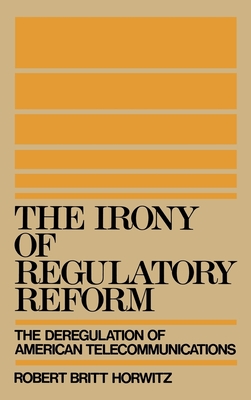
The Irony of Regulatory Reform
| AUTHOR | Horwitz, Robert Britt |
| PUBLISHER | Oxford University Press (12/15/1988) |
| PRODUCT TYPE | Hardcover (Hardcover) |
Description
Deregulation was a political buzzword of the early 1980's. The Reagan Administration came to power on a platform dedicated to getting government "off the backs of the people." Deregulation promised to lower inflation, raise productivity, and reverse the sagging fortunes of American industry. And proponents declared deregulation morally right because it constituted a rollback of the arbitrary power of the state in favor of individual initiative and liberty. But the actual politics of deregulation, including the momentous breakup of AT&T, had already turned out to be far more complex than this rhetoric suggested. In The Irony of Regulatory Reform Horwitz examines the history of telecommunications--both telephone and broadcast--to build a compelling new theory of regulation. Against the backdrop of modern theories of the state, he presents a sweeping survey of the history of regulation in America, delineating three distinct periods of regulatory genesis and, correspondingly, three discrete types of agencies. Horwitz shows the underlying irony that while anti-regulation rhetoric was aimed at the so-called "social" regulatory agencies, in practice it has been the "economic" agencies that have been deregulated, often with vehement opposition from the industries affected. Within the context of this broader theory, telecommunications is a fascinating industry to study, because it determines the character of our marketplace of ideas, because it has been an arena of great technological transformation, and because of its fundamental role in anchoring the so-called "information age." Horwitz unveils the complex mosaic of forces--economic, political, legal, and technological--that undermined the traditional regulation of telecommunications and precipitated deregulation.
Show More
Product Format
Product Details
ISBN-13:
9780195054453
ISBN-10:
0195054458
Binding:
Hardback or Cased Book (Sewn)
Content Language:
English
More Product Details
Page Count:
424
Carton Quantity:
16
Product Dimensions:
6.55 x 1.29 x 9.52 inches
Weight:
1.64 pound(s)
Feature Codes:
Bibliography,
Index
Country of Origin:
US
Subject Information
BISAC Categories
Technology & Engineering | Telecommunications
Technology & Engineering | Media Studies
Technology & Engineering | Industries - Media & Communications
Dewey Decimal:
384.041
Library of Congress Control Number:
88005962
Descriptions, Reviews, Etc.
publisher marketing
Deregulation was a political buzzword of the early 1980's. The Reagan Administration came to power on a platform dedicated to getting government "off the backs of the people." Deregulation promised to lower inflation, raise productivity, and reverse the sagging fortunes of American industry. And proponents declared deregulation morally right because it constituted a rollback of the arbitrary power of the state in favor of individual initiative and liberty. But the actual politics of deregulation, including the momentous breakup of AT&T, had already turned out to be far more complex than this rhetoric suggested. In The Irony of Regulatory Reform Horwitz examines the history of telecommunications--both telephone and broadcast--to build a compelling new theory of regulation. Against the backdrop of modern theories of the state, he presents a sweeping survey of the history of regulation in America, delineating three distinct periods of regulatory genesis and, correspondingly, three discrete types of agencies. Horwitz shows the underlying irony that while anti-regulation rhetoric was aimed at the so-called "social" regulatory agencies, in practice it has been the "economic" agencies that have been deregulated, often with vehement opposition from the industries affected. Within the context of this broader theory, telecommunications is a fascinating industry to study, because it determines the character of our marketplace of ideas, because it has been an arena of great technological transformation, and because of its fundamental role in anchoring the so-called "information age." Horwitz unveils the complex mosaic of forces--economic, political, legal, and technological--that undermined the traditional regulation of telecommunications and precipitated deregulation.
Show More
Author:
Horwitz, Robert Britt
Robert Britt Horwitz is Associate Professor of Communication at the University of California, San Diego.
Show More
List Price $61.00
Your Price
$60.39