
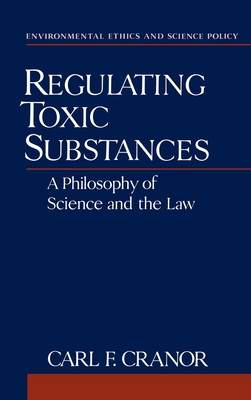
Regulating Toxic Substances: A Philosophy of Science and the Law
| AUTHOR | Brown, George E., Jr.; Cranor, Carl F. |
| PUBLISHER | Oxford University Press (02/18/1993) |
| PRODUCT TYPE | Hardcover (Hardcover) |
Description
The proliferation of chemical substances in commerce poses significant scientific and philosophical problems. The scientific challenge is to develop data, methodologies and techniques for identifying and assessing toxic substances before they cause harm to human beings or the environment. The philosophical problem is to determine how much scientific information we should demand for this task consistent with the pursuit of other social goals. In this book, Carl Cranor utilizes material from ethics, philosophy of law, epidemiology, tort law, regulatory law, and risk assessment to argue that the evidentiary standards for science used in the law to control toxics ought to be evaluated with the purposes of the law in mind. Demanding too much for this purpose will slow the evaluation and lead to an excess of toxic substances left unidentified and unassessed, thus leaving the public at risk. Demanding too little may impose other costs. Analyzing this tension philosophically, Cranor argues for an appropriate balance between these social concerns. Although the use of somewhat less stringent evidentiary standards for expert testimony in tort law cases and the use of expedited procedures in the regulatory field might in some cases lead to mistakes of overcompensation or overregulation, the overall social costs would be less than the alternatives. Justice requires that we tolerate the chance of such errors and that we resist the temptation to demand the most science intensive evaluation of each substance in order to protect individuals better from mistakes of undercompensation and underregulation. The role of science in the control of toxic substances is an important public philosophical issue, yetuntil now has received little discussion by philosophers. Regulating Toxic Substances addresses this subject in a way that speaks both to a well-informed public and to experts in several disciplines, including philosophy, risk assessment, environmental and tort law, env
Show More
Product Format
Product Details
ISBN-13:
9780195074369
ISBN-10:
019507436X
Binding:
Hardback or Cased Book (Sewn)
Content Language:
English
More Product Details
Page Count:
272
Carton Quantity:
22
Product Dimensions:
6.34 x 0.89 x 9.36 inches
Weight:
1.32 pound(s)
Feature Codes:
Bibliography,
Index,
Table of Contents,
Illustrated
Country of Origin:
GB
Subject Information
BISAC Categories
Science | Environmental Science (see also Chemistry - Environmental)
Science | History & Surveys - Modern
Science | Philosophy & Social Aspects
Accelerated Reader:
Reading Level:
0
Point Value:
0
Guided Reading Level:
Not Applicable
Dewey Decimal:
347.304
Library of Congress Control Number:
91047046
Descriptions, Reviews, Etc.
publisher marketing
The proliferation of chemical substances in commerce poses significant scientific and philosophical problems. The scientific challenge is to develop data, methodologies and techniques for identifying and assessing toxic substances before they cause harm to human beings or the environment. The philosophical problem is to determine how much scientific information we should demand for this task consistent with the pursuit of other social goals. In this book, Carl Cranor utilizes material from ethics, philosophy of law, epidemiology, tort law, regulatory law, and risk assessment to argue that the evidentiary standards for science used in the law to control toxics ought to be evaluated with the purposes of the law in mind. Demanding too much for this purpose will slow the evaluation and lead to an excess of toxic substances left unidentified and unassessed, thus leaving the public at risk. Demanding too little may impose other costs. Analyzing this tension philosophically, Cranor argues for an appropriate balance between these social concerns. Although the use of somewhat less stringent evidentiary standards for expert testimony in tort law cases and the use of expedited procedures in the regulatory field might in some cases lead to mistakes of overcompensation or overregulation, the overall social costs would be less than the alternatives. Justice requires that we tolerate the chance of such errors and that we resist the temptation to demand the most science intensive evaluation of each substance in order to protect individuals better from mistakes of undercompensation and underregulation. The role of science in the control of toxic substances is an important public philosophical issue, yetuntil now has received little discussion by philosophers. Regulating Toxic Substances addresses this subject in a way that speaks both to a well-informed public and to experts in several disciplines, including philosophy, risk assessment, environmental and tort law, env
Show More
Author:
Cranor, Carl F.
Carl F. Cranor is Professor of Philosophy at the University of California, Riverside. His work focuses on issues that arise in the legal and scientific adjudication of risks from toxic substances and from the new genetic technologies. He has published numerous articles in these fields as well as authoring Regulating Toxic Substances: A Philosophy of Science and the Law (1993), editing Are Genes Us? The Social Consequences of the New Genetics (1994) and co-authoring the US Congress' Office of Technology Assessment report, Identifying and Regulating Carcinogens (1987). His articles have appeared in diverse journals such as The American Philosophical Quarterly, The Yale Law Journal, and the American Journal of Public Health. He is a member of the Center for Progressive Reform, a virtual think tank comprised of academic scholars interested in protecting public health and the environment.
Show More
Foreword by:
Brown, George E., Jr.
George E. Brown (1917-1980) earned his diploma in horticulture at the Royal Botanic Gardens, Kew. He returned to Kew in 1956 as an assistant curator. A founding member of the Arboricultural Association, he soon became a recognized authority on trees and shrubs.
Show More
List Price $58.00
Your Price
$57.42