
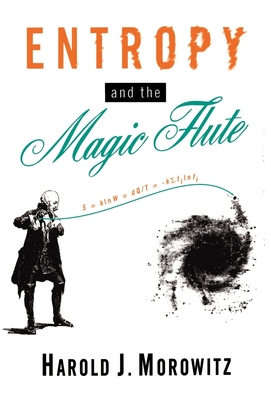
Entropy and the Magic Flute
| AUTHOR | Morowitz, Harold J. |
| PUBLISHER | Oxford University Press (06/10/1993) |
| PRODUCT TYPE | Hardcover (Hardcover) |
Description
Harold Morowitz has long been regarded highly both as an eminent scientist and as an accomplished science writer. The essays in The Wine of Life, his first collection, were hailed by C.P. Snow as "some of the wisest, wittiest and best informed that I have read," and Carl Sagan called them "a delight to read." In later volumes such as Mayonnaise and the Origin of Life and The Thermodynamics of Pizza, he has established a reputation for a wide-ranging intellect, an ability to see unexpected connections and draw striking parallels, and a talent for communicating scientific ideas with optimism and wit. Kirkus Reviews praised Mayonnaise as "wonderfully diverting and very wise." Nature wrote of Thermodynamics, "his chocolate-coated nuggets of science will continue to entertain and do surreptitious good."
With Entropy and the Magic Flute, Morowitz once again offers an appealing mix of brief reflections on everything from litmus paper to the hippopotamus to the sociology of Palo Alto coffee shops. Many of these pieces are appreciations of scientists that Morowitz holds in high regard. In the title piece, for instance, Morowitz tells of his pilgrimage to the grave of Ludwig Boltzmann, buried in the same cemetery--Vienna's Central Cemetery--as Beethoven, Schubert, and Brahms. He also writes of J. Willard Gibbs ("thought by many to be the greatest scientist yet produced by the United States"), Jean Perrin (author of Les Atomes, a now-forgotten classic that convinced virtually everyone in science of the validity of the atomic hypothesis), Einstein, Newton (on the occasion of the 300th anniversary of his Principia, a date that passed virtually unnoticed except by Morowitz), Murray Gell-Mann, and Aristotle. Of Aristotle, Morowitz observes that "most people whose information comes from academic philosophy fail to appreciate that--among his many fields of expertise--first and foremost, Aristotle was a biologist." Indeed, fully a third of Aristotle's writings are on the life sciences, almost all of which has been left out of standard editions of his work. Many other pieces focus on health issues--such as America's obsession with cheese toppings, the addiction to smoking of otherwise intelligent people, questionable obstetric practices--and several touch upon ethics, whistle-blowing, and scientific research. There is also a fascinating piece on the American Type Culture Collection, a zoo or warehouse for microbes that houses some 11,800 strains of bacteria, and over 3,000 specimens of protozoa, algae, plasmids, and oncogenes.
Here then are over forty light, graceful essays in which one of our wisest experimental biologists comments on issues of science, technology, society, philosophy, and the arts.
With Entropy and the Magic Flute, Morowitz once again offers an appealing mix of brief reflections on everything from litmus paper to the hippopotamus to the sociology of Palo Alto coffee shops. Many of these pieces are appreciations of scientists that Morowitz holds in high regard. In the title piece, for instance, Morowitz tells of his pilgrimage to the grave of Ludwig Boltzmann, buried in the same cemetery--Vienna's Central Cemetery--as Beethoven, Schubert, and Brahms. He also writes of J. Willard Gibbs ("thought by many to be the greatest scientist yet produced by the United States"), Jean Perrin (author of Les Atomes, a now-forgotten classic that convinced virtually everyone in science of the validity of the atomic hypothesis), Einstein, Newton (on the occasion of the 300th anniversary of his Principia, a date that passed virtually unnoticed except by Morowitz), Murray Gell-Mann, and Aristotle. Of Aristotle, Morowitz observes that "most people whose information comes from academic philosophy fail to appreciate that--among his many fields of expertise--first and foremost, Aristotle was a biologist." Indeed, fully a third of Aristotle's writings are on the life sciences, almost all of which has been left out of standard editions of his work. Many other pieces focus on health issues--such as America's obsession with cheese toppings, the addiction to smoking of otherwise intelligent people, questionable obstetric practices--and several touch upon ethics, whistle-blowing, and scientific research. There is also a fascinating piece on the American Type Culture Collection, a zoo or warehouse for microbes that houses some 11,800 strains of bacteria, and over 3,000 specimens of protozoa, algae, plasmids, and oncogenes.
Here then are over forty light, graceful essays in which one of our wisest experimental biologists comments on issues of science, technology, society, philosophy, and the arts.
Show More
Product Format
Product Details
ISBN-13:
9780195081992
ISBN-10:
0195081994
Binding:
Hardback or Cased Book (Sewn)
Content Language:
English
More Product Details
Page Count:
240
Carton Quantity:
26
Product Dimensions:
6.14 x 0.82 x 8.52 inches
Weight:
1.08 pound(s)
Feature Codes:
Dust Cover
Country of Origin:
GB
Subject Information
BISAC Categories
Science | Essays
Science | Essays
Science | Essays
Dewey Decimal:
500
Library of Congress Control Number:
92027935
Descriptions, Reviews, Etc.
publisher marketing
Harold Morowitz has long been regarded highly both as an eminent scientist and as an accomplished science writer. The essays in The Wine of Life, his first collection, were hailed by C.P. Snow as "some of the wisest, wittiest and best informed that I have read," and Carl Sagan called them "a delight to read." In later volumes such as Mayonnaise and the Origin of Life and The Thermodynamics of Pizza, he has established a reputation for a wide-ranging intellect, an ability to see unexpected connections and draw striking parallels, and a talent for communicating scientific ideas with optimism and wit. Kirkus Reviews praised Mayonnaise as "wonderfully diverting and very wise." Nature wrote of Thermodynamics, "his chocolate-coated nuggets of science will continue to entertain and do surreptitious good."
With Entropy and the Magic Flute, Morowitz once again offers an appealing mix of brief reflections on everything from litmus paper to the hippopotamus to the sociology of Palo Alto coffee shops. Many of these pieces are appreciations of scientists that Morowitz holds in high regard. In the title piece, for instance, Morowitz tells of his pilgrimage to the grave of Ludwig Boltzmann, buried in the same cemetery--Vienna's Central Cemetery--as Beethoven, Schubert, and Brahms. He also writes of J. Willard Gibbs ("thought by many to be the greatest scientist yet produced by the United States"), Jean Perrin (author of Les Atomes, a now-forgotten classic that convinced virtually everyone in science of the validity of the atomic hypothesis), Einstein, Newton (on the occasion of the 300th anniversary of his Principia, a date that passed virtually unnoticed except by Morowitz), Murray Gell-Mann, and Aristotle. Of Aristotle, Morowitz observes that "most people whose information comes from academic philosophy fail to appreciate that--among his many fields of expertise--first and foremost, Aristotle was a biologist." Indeed, fully a third of Aristotle's writings are on the life sciences, almost all of which has been left out of standard editions of his work. Many other pieces focus on health issues--such as America's obsession with cheese toppings, the addiction to smoking of otherwise intelligent people, questionable obstetric practices--and several touch upon ethics, whistle-blowing, and scientific research. There is also a fascinating piece on the American Type Culture Collection, a zoo or warehouse for microbes that houses some 11,800 strains of bacteria, and over 3,000 specimens of protozoa, algae, plasmids, and oncogenes.
Here then are over forty light, graceful essays in which one of our wisest experimental biologists comments on issues of science, technology, society, philosophy, and the arts.
With Entropy and the Magic Flute, Morowitz once again offers an appealing mix of brief reflections on everything from litmus paper to the hippopotamus to the sociology of Palo Alto coffee shops. Many of these pieces are appreciations of scientists that Morowitz holds in high regard. In the title piece, for instance, Morowitz tells of his pilgrimage to the grave of Ludwig Boltzmann, buried in the same cemetery--Vienna's Central Cemetery--as Beethoven, Schubert, and Brahms. He also writes of J. Willard Gibbs ("thought by many to be the greatest scientist yet produced by the United States"), Jean Perrin (author of Les Atomes, a now-forgotten classic that convinced virtually everyone in science of the validity of the atomic hypothesis), Einstein, Newton (on the occasion of the 300th anniversary of his Principia, a date that passed virtually unnoticed except by Morowitz), Murray Gell-Mann, and Aristotle. Of Aristotle, Morowitz observes that "most people whose information comes from academic philosophy fail to appreciate that--among his many fields of expertise--first and foremost, Aristotle was a biologist." Indeed, fully a third of Aristotle's writings are on the life sciences, almost all of which has been left out of standard editions of his work. Many other pieces focus on health issues--such as America's obsession with cheese toppings, the addiction to smoking of otherwise intelligent people, questionable obstetric practices--and several touch upon ethics, whistle-blowing, and scientific research. There is also a fascinating piece on the American Type Culture Collection, a zoo or warehouse for microbes that houses some 11,800 strains of bacteria, and over 3,000 specimens of protozoa, algae, plasmids, and oncogenes.
Here then are over forty light, graceful essays in which one of our wisest experimental biologists comments on issues of science, technology, society, philosophy, and the arts.
Show More
Author:
Morowitz, Harold J.
About the Authors:
Harold J. Morowitz is the Clarence J. Robinson Professor of Biology and Natural Philosophy at George Mason University and the author of The Thermodynamics of Pizza and Cosmic Joy and Local Pain. James S. Trefil is the Clarence J. Robinson Professor of Physics at George Mason University. He is the
coauthor of Dictionary of Cultural Literacy and Science Matters: Achieving Scientific Literacy.
Harold J. Morowitz is the Clarence J. Robinson Professor of Biology and Natural Philosophy at George Mason University and the author of The Thermodynamics of Pizza and Cosmic Joy and Local Pain. James S. Trefil is the Clarence J. Robinson Professor of Physics at George Mason University. He is the
coauthor of Dictionary of Cultural Literacy and Science Matters: Achieving Scientific Literacy.
Show More
List Price $65.00
Your Price
$64.35