
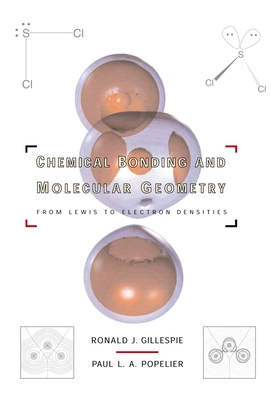
Chemical Bonding and Molecular Geometry: From Lewis to Electron Densities
| AUTHOR | Popelier, Paul L. a.; Gillespie, R. J.; Popelier, Paul L. a. et al. |
| PUBLISHER | Oxford University Press (03/08/2001) |
| PRODUCT TYPE | Paperback (Paperback) |
Description
Ideal for undergraduate and first-year graduate courses in chemical bonding, Chemical Bonding and Molecular Geometry: From Lewis to Electron Densities can also be used in inorganic chemistry courses. Authored by Ronald Gillespie, a world-class chemist and expert on chemical bonding, and Paul Popelier of the University of Manchester Institute of Science and Technology, this text provides students with a comprehensive and detailed introduction to the principal models and theories of chemical bonding and geometry. It also serves as a useful resource and an up-to-date introduction to modern developments in the field for instructors teaching chemical bonding at any level. Features:
* Shows students how the concept of the chemical bond has developed from its earliest days, through Lewis's brilliant concept of the electron pair bond and up to the present day
* Presents a novel, non-traditional approach that emphasizes the importance of the Pauli principle as a basis for understanding bonding
* Begins with the fundamental classical concepts and proceeds through orbital models to recent ideas based on the analysis of electron densities, which help to clarify and emphasize many of the limitations of earlier models
* Provides a thorough and up-to-date treatment of the well-known valence-shell electron pair (VSEPR) model (which was first formulated and developed by author Ronald Gillespie) and the more recent ligand close-packing (LCP) model
* Presents a unique pictorial and nonmathematical discussion of the analysis of electron density distributions using the atoms in molecules (AIM) theory
* Emphasizes the relationships between these various models, giving examples of their uses, limitations, and comparative advantages and disadvantages
* Shows students how the concept of the chemical bond has developed from its earliest days, through Lewis's brilliant concept of the electron pair bond and up to the present day
* Presents a novel, non-traditional approach that emphasizes the importance of the Pauli principle as a basis for understanding bonding
* Begins with the fundamental classical concepts and proceeds through orbital models to recent ideas based on the analysis of electron densities, which help to clarify and emphasize many of the limitations of earlier models
* Provides a thorough and up-to-date treatment of the well-known valence-shell electron pair (VSEPR) model (which was first formulated and developed by author Ronald Gillespie) and the more recent ligand close-packing (LCP) model
* Presents a unique pictorial and nonmathematical discussion of the analysis of electron density distributions using the atoms in molecules (AIM) theory
* Emphasizes the relationships between these various models, giving examples of their uses, limitations, and comparative advantages and disadvantages
Show More
Product Format
Product Details
ISBN-13:
9780195104967
ISBN-10:
019510496X
Binding:
Paperback or Softback (Trade Paperback (Us))
Content Language:
English
More Product Details
Page Count:
288
Carton Quantity:
30
Product Dimensions:
6.50 x 0.53 x 9.20 inches
Weight:
0.95 pound(s)
Country of Origin:
GB
Subject Information
BISAC Categories
Science | Chemistry - Physical & Theoretical
Science | History
Science | Chemistry - Inorganic
Dewey Decimal:
541.224
Library of Congress Control Number:
00025404
Descriptions, Reviews, Etc.
publisher marketing
Ideal for undergraduate and first-year graduate courses in chemical bonding, Chemical Bonding and Molecular Geometry: From Lewis to Electron Densities can also be used in inorganic chemistry courses. Authored by Ronald Gillespie, a world-class chemist and expert on chemical bonding, and Paul Popelier of the University of Manchester Institute of Science and Technology, this text provides students with a comprehensive and detailed introduction to the principal models and theories of chemical bonding and geometry. It also serves as a useful resource and an up-to-date introduction to modern developments in the field for instructors teaching chemical bonding at any level. Features:
* Shows students how the concept of the chemical bond has developed from its earliest days, through Lewis's brilliant concept of the electron pair bond and up to the present day
* Presents a novel, non-traditional approach that emphasizes the importance of the Pauli principle as a basis for understanding bonding
* Begins with the fundamental classical concepts and proceeds through orbital models to recent ideas based on the analysis of electron densities, which help to clarify and emphasize many of the limitations of earlier models
* Provides a thorough and up-to-date treatment of the well-known valence-shell electron pair (VSEPR) model (which was first formulated and developed by author Ronald Gillespie) and the more recent ligand close-packing (LCP) model
* Presents a unique pictorial and nonmathematical discussion of the analysis of electron density distributions using the atoms in molecules (AIM) theory
* Emphasizes the relationships between these various models, giving examples of their uses, limitations, and comparative advantages and disadvantages
* Shows students how the concept of the chemical bond has developed from its earliest days, through Lewis's brilliant concept of the electron pair bond and up to the present day
* Presents a novel, non-traditional approach that emphasizes the importance of the Pauli principle as a basis for understanding bonding
* Begins with the fundamental classical concepts and proceeds through orbital models to recent ideas based on the analysis of electron densities, which help to clarify and emphasize many of the limitations of earlier models
* Provides a thorough and up-to-date treatment of the well-known valence-shell electron pair (VSEPR) model (which was first formulated and developed by author Ronald Gillespie) and the more recent ligand close-packing (LCP) model
* Presents a unique pictorial and nonmathematical discussion of the analysis of electron density distributions using the atoms in molecules (AIM) theory
* Emphasizes the relationships between these various models, giving examples of their uses, limitations, and comparative advantages and disadvantages
Show More
Your Price
$222.75