
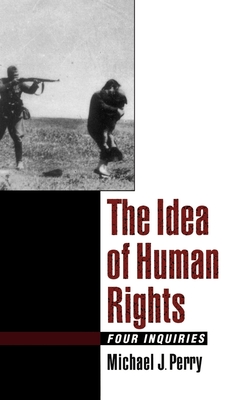
The Idea of Human Rights: Four Inquiries
| AUTHOR | Perry, Michael J. |
| PUBLISHER | Oxford University Press (01/08/1998) |
| PRODUCT TYPE | Hardcover (Hardcover) |
Description
Inspired by a 1988 trip to El Salvador, Michael J. Perry's new book is a personal and scholarly exploration of the idea of human rights. Perry is one of our nation's leading authorities on the relation of morality, including religious morality, to politics and law. He seeks, in this book, to disentangle the complex idea of human rights by way of four probing and interrelated essays. * The initial essay, which is animated by Perry's skepticism about the capacity of any secular morality to offer a coherent account of the idea of human rights, suggests that the first part of the idea of human rights--the premise that every human being is "sacred" or "inviolable"--is inescapably religious. * Responding to recent criticism of "rights talk", Perry explicates, in his second essay, the meaning and value of talk about human rights. * In his third essay, Perry asks a fundamental question about human rights: Are they universal? In addressing this question, he disaggregates and criticizes several different varieties of "moral relativism" and then considers the implications of these different relativist positions for claims about human rights. * Perry turns to another fundamental question about human rights in his final essay: Are they absolute? He concludes that even if no human rights, understood as moral rights, are absolute or unconditional, some human rights, understood as international legal rights, are--and indeed, should be--absolute. In the introduction, Perry writes: "Of all the influential--indeed, formative--moral ideas to take center stage in the twentieth century, like democracy and socialism, the idea of human rights (which, again, in one form or another, is an old idea) is, for many, the most difficult. It is the most difficult in the sense that it is, for many, the hardest of the great moral ideas to integrate, the hardest to square, with the reigning intellectual assumptions of the age, especially what Bernard Williams has called 'Nietzsche's thought': 'There is not only no God, but no metaphysical order of any kind....' For those who accept 'Nietzsche's thought', can the idea of human rights possibly be more than a kind of aesthetic preference? In a culture in which it was widely believed that there is no God or metaphysical order of any kind, on what basis, if any, could the idea of human rights long survive?" The Idea of Human Rights: Four Inquiries will appeal to students of many disciplines, including (but not limited to) law, philosophy, religion, and politics.
Show More
Product Format
Product Details
ISBN-13:
9780195116366
ISBN-10:
0195116364
Binding:
Hardback or Cased Book (Sewn)
Content Language:
English
More Product Details
Page Count:
176
Carton Quantity:
32
Product Dimensions:
6.46 x 0.74 x 9.51 inches
Weight:
0.93 pound(s)
Feature Codes:
Index,
Table of Contents
Country of Origin:
GB
Subject Information
BISAC Categories
Political Science | Human Rights
Political Science | Civil Rights
Political Science | History & Theory - General
Accelerated Reader:
Reading Level:
0
Point Value:
0
Guided Reading Level:
Not Applicable
Dewey Decimal:
323.01
Library of Congress Control Number:
97012764
Descriptions, Reviews, Etc.
publisher marketing
Inspired by a 1988 trip to El Salvador, Michael J. Perry's new book is a personal and scholarly exploration of the idea of human rights. Perry is one of our nation's leading authorities on the relation of morality, including religious morality, to politics and law. He seeks, in this book, to disentangle the complex idea of human rights by way of four probing and interrelated essays. * The initial essay, which is animated by Perry's skepticism about the capacity of any secular morality to offer a coherent account of the idea of human rights, suggests that the first part of the idea of human rights--the premise that every human being is "sacred" or "inviolable"--is inescapably religious. * Responding to recent criticism of "rights talk", Perry explicates, in his second essay, the meaning and value of talk about human rights. * In his third essay, Perry asks a fundamental question about human rights: Are they universal? In addressing this question, he disaggregates and criticizes several different varieties of "moral relativism" and then considers the implications of these different relativist positions for claims about human rights. * Perry turns to another fundamental question about human rights in his final essay: Are they absolute? He concludes that even if no human rights, understood as moral rights, are absolute or unconditional, some human rights, understood as international legal rights, are--and indeed, should be--absolute. In the introduction, Perry writes: "Of all the influential--indeed, formative--moral ideas to take center stage in the twentieth century, like democracy and socialism, the idea of human rights (which, again, in one form or another, is an old idea) is, for many, the most difficult. It is the most difficult in the sense that it is, for many, the hardest of the great moral ideas to integrate, the hardest to square, with the reigning intellectual assumptions of the age, especially what Bernard Williams has called 'Nietzsche's thought': 'There is not only no God, but no metaphysical order of any kind....' For those who accept 'Nietzsche's thought', can the idea of human rights possibly be more than a kind of aesthetic preference? In a culture in which it was widely believed that there is no God or metaphysical order of any kind, on what basis, if any, could the idea of human rights long survive?" The Idea of Human Rights: Four Inquiries will appeal to students of many disciplines, including (but not limited to) law, philosophy, religion, and politics.
Show More
Author:
Perry, Michael J.
Michael J. Perry holds a Robert W. Woodruff Chair at Emory University, where he teaches in the law school. Previously, Perry held the Howard J. Trienens Chair in Law at Northwestern University, where he taught for fifteen years, and the University Distinguished Chair in Law at Wake Forest University. Perry has written on American constitutional law and theory; law, morality and religion; and human rights theory in more than sixty articles and eleven books, including The Political Morality of Liberal Democracy, The Idea of Human Rights, We the People: The Fourteenth Amendment and the Supreme Court, Under God? Religious Faith and Liberal Democracy, Toward a Theory of Human Rights: Religion, Law, Courts, and Constitutional Rights, Moral Controversy, and the Supreme Court.
Show More
List Price $160.00
Your Price
$158.40