
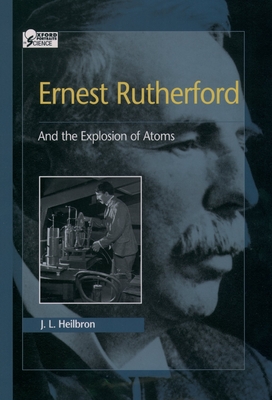
Ernest Rutherford: And the Explosion of Atoms
| AUTHOR | Heilbron, J. L. |
| PUBLISHER | Oxford University Press, USA (06/12/2003) |
| PRODUCT TYPE | Hardcover (Hardcover) |
Description
An engaging biography that captures the excitement of the early days of nuclear physics, Ernest Rutherford tells the story of the down-to-earth New Zealander who became one of the foremost pioneers of subatomic physics. Rutherford's achievements were numerous and included:
* Inventing a detector for electromagnetic waves
* Discovering the existence of alpha and beta rays in uranium radiation
* Creating (with Frederick Soddy) the disintegration theory of radioactivity, which regards radioactive phenomena as atomic -- not molecular -- processes
* Demonstrating that the inner structures of elements correspond with a group of lines that characterize them, which could then be assigned an atomic number and, more important, the properties of each element could be defined by this number
* And his greatest contribution of all - he discovered that the atom had a nucleus and that it contained the positively charged proton
From his early days as a scholarship student to the end of his life as he continued to work in his lab, Ernest Rutherford reveals the life and times of one of the greatest minds of the twentieth century. Oxford Portraits in Science is an on-going series of scientific biographies for young adults. Written by top scholars and writers, each biography examines the personality of its subject as well as the thought process leading to his or her discoveries. These illustrated biographies combine accessible technical information with compelling personal stories to portray the scientists whose work has shaped our understanding of the natural world.
* Inventing a detector for electromagnetic waves
* Discovering the existence of alpha and beta rays in uranium radiation
* Creating (with Frederick Soddy) the disintegration theory of radioactivity, which regards radioactive phenomena as atomic -- not molecular -- processes
* Demonstrating that the inner structures of elements correspond with a group of lines that characterize them, which could then be assigned an atomic number and, more important, the properties of each element could be defined by this number
* And his greatest contribution of all - he discovered that the atom had a nucleus and that it contained the positively charged proton
From his early days as a scholarship student to the end of his life as he continued to work in his lab, Ernest Rutherford reveals the life and times of one of the greatest minds of the twentieth century. Oxford Portraits in Science is an on-going series of scientific biographies for young adults. Written by top scholars and writers, each biography examines the personality of its subject as well as the thought process leading to his or her discoveries. These illustrated biographies combine accessible technical information with compelling personal stories to portray the scientists whose work has shaped our understanding of the natural world.
Show More
Product Format
Product Details
ISBN-13:
9780195123784
ISBN-10:
0195123786
Binding:
Hardback or Cased Book (Sewn)
Content Language:
English
More Product Details
Page Count:
144
Carton Quantity:
1
Product Dimensions:
6.88 x 0.59 x 9.56 inches
Weight:
1.00 pound(s)
Feature Codes:
Bibliography,
Index,
Ikids,
Illustrated
Country of Origin:
GB
Subject Information
BISAC Categories
Biography & Autobiography | Science & Technology
Grade Level:
7th Grade
- 12th Grade
Dewey Decimal:
B
Library of Congress Control Number:
2002155600
Descriptions, Reviews, Etc.
publisher marketing
An engaging biography that captures the excitement of the early days of nuclear physics, Ernest Rutherford tells the story of the down-to-earth New Zealander who became one of the foremost pioneers of subatomic physics. Rutherford's achievements were numerous and included:
* Inventing a detector for electromagnetic waves
* Discovering the existence of alpha and beta rays in uranium radiation
* Creating (with Frederick Soddy) the disintegration theory of radioactivity, which regards radioactive phenomena as atomic -- not molecular -- processes
* Demonstrating that the inner structures of elements correspond with a group of lines that characterize them, which could then be assigned an atomic number and, more important, the properties of each element could be defined by this number
* And his greatest contribution of all - he discovered that the atom had a nucleus and that it contained the positively charged proton
From his early days as a scholarship student to the end of his life as he continued to work in his lab, Ernest Rutherford reveals the life and times of one of the greatest minds of the twentieth century. Oxford Portraits in Science is an on-going series of scientific biographies for young adults. Written by top scholars and writers, each biography examines the personality of its subject as well as the thought process leading to his or her discoveries. These illustrated biographies combine accessible technical information with compelling personal stories to portray the scientists whose work has shaped our understanding of the natural world.
* Inventing a detector for electromagnetic waves
* Discovering the existence of alpha and beta rays in uranium radiation
* Creating (with Frederick Soddy) the disintegration theory of radioactivity, which regards radioactive phenomena as atomic -- not molecular -- processes
* Demonstrating that the inner structures of elements correspond with a group of lines that characterize them, which could then be assigned an atomic number and, more important, the properties of each element could be defined by this number
* And his greatest contribution of all - he discovered that the atom had a nucleus and that it contained the positively charged proton
From his early days as a scholarship student to the end of his life as he continued to work in his lab, Ernest Rutherford reveals the life and times of one of the greatest minds of the twentieth century. Oxford Portraits in Science is an on-going series of scientific biographies for young adults. Written by top scholars and writers, each biography examines the personality of its subject as well as the thought process leading to his or her discoveries. These illustrated biographies combine accessible technical information with compelling personal stories to portray the scientists whose work has shaped our understanding of the natural world.
Show More
Author:
Heilbron, J. L.
J. L. Heilbron, formerly Professor of History and the Vice Chancellor at the University of California, Berkeley, is a Senior Research Fellow at Worcester College, University of Oxford. He was awarded the George Sarton Medal by the History of Science Society in 1993 for his contributions to the field.
Show More
Your Price
$32.62