
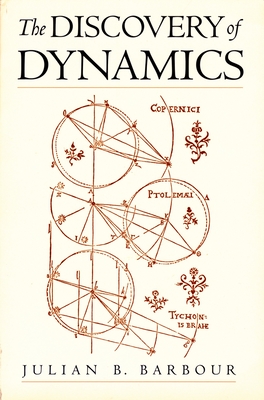
The Discovery of Dynamics: A Study from a Machian Point of View of the Discovery and the Structure of Dynamical Theories
| AUTHOR | Barbour, Julian B. |
| PUBLISHER | Oxford University Press (09/06/2001) |
| PRODUCT TYPE | Paperback (Paperback) |
Description
Ever since Newton created dynamics, there has been controversy about its foundations. Are space and time absolute? Do they form a rigid but invisible framework and container of the universe? Or are space, time, and motion relative? If so, does Newton's 'framework' arise through the influence of the universe at large, as Ernst Mach suggested? Einstein's aim when creating his general theory of relativity was to demonstrate this and thereby implement 'Mach's Principle'. However, it is widely believed that he achieved only partial success. This question of whether motion is absolute or relative has been a central issues in philosophy; the nature of time has perennial interest. Current attempts to create a quantum description of the whole universe keep these issues at the cutting edge of modern research.
Written by the world's leading expert on Mach's Principle, The Discovery of Dynamics is a highly original account of the development of notions about space, time, and motion. Widely praised in its hardback version, it is one of the fullest and most readable accounts of the astronomical studies that culminated in Kepler's laws of planetary motion and of the creation of dynamics by Galileo, Descartes, Huygens, and Newton. Originally published as Absolute or Relative Motion?, Vol. 1: The Discovery of Dynamics (Cambridge), The Discovery of Dynamics provides the technical background to Barbour's recently published The End of Time, in which he argues that time disappears from the description of the quantum universe.
Written by the world's leading expert on Mach's Principle, The Discovery of Dynamics is a highly original account of the development of notions about space, time, and motion. Widely praised in its hardback version, it is one of the fullest and most readable accounts of the astronomical studies that culminated in Kepler's laws of planetary motion and of the creation of dynamics by Galileo, Descartes, Huygens, and Newton. Originally published as Absolute or Relative Motion?, Vol. 1: The Discovery of Dynamics (Cambridge), The Discovery of Dynamics provides the technical background to Barbour's recently published The End of Time, in which he argues that time disappears from the description of the quantum universe.
Show More
Product Format
Product Details
ISBN-13:
9780195132021
ISBN-10:
0195132025
Binding:
Paperback or Softback (Trade Paperback (Us))
Content Language:
English
More Product Details
Page Count:
784
Carton Quantity:
12
Product Dimensions:
6.16 x 1.64 x 9.29 inches
Weight:
2.45 pound(s)
Feature Codes:
Bibliography,
Index,
Illustrated
Country of Origin:
GB
Subject Information
BISAC Categories
Science | Mechanics - Dynamics
Science | History
Science | Physics - Relativity
Dewey Decimal:
531.11
Library of Congress Control Number:
00062340
Descriptions, Reviews, Etc.
publisher marketing
Ever since Newton created dynamics, there has been controversy about its foundations. Are space and time absolute? Do they form a rigid but invisible framework and container of the universe? Or are space, time, and motion relative? If so, does Newton's 'framework' arise through the influence of the universe at large, as Ernst Mach suggested? Einstein's aim when creating his general theory of relativity was to demonstrate this and thereby implement 'Mach's Principle'. However, it is widely believed that he achieved only partial success. This question of whether motion is absolute or relative has been a central issues in philosophy; the nature of time has perennial interest. Current attempts to create a quantum description of the whole universe keep these issues at the cutting edge of modern research.
Written by the world's leading expert on Mach's Principle, The Discovery of Dynamics is a highly original account of the development of notions about space, time, and motion. Widely praised in its hardback version, it is one of the fullest and most readable accounts of the astronomical studies that culminated in Kepler's laws of planetary motion and of the creation of dynamics by Galileo, Descartes, Huygens, and Newton. Originally published as Absolute or Relative Motion?, Vol. 1: The Discovery of Dynamics (Cambridge), The Discovery of Dynamics provides the technical background to Barbour's recently published The End of Time, in which he argues that time disappears from the description of the quantum universe.
Written by the world's leading expert on Mach's Principle, The Discovery of Dynamics is a highly original account of the development of notions about space, time, and motion. Widely praised in its hardback version, it is one of the fullest and most readable accounts of the astronomical studies that culminated in Kepler's laws of planetary motion and of the creation of dynamics by Galileo, Descartes, Huygens, and Newton. Originally published as Absolute or Relative Motion?, Vol. 1: The Discovery of Dynamics (Cambridge), The Discovery of Dynamics provides the technical background to Barbour's recently published The End of Time, in which he argues that time disappears from the description of the quantum universe.
Show More
Author:
Barbour, Julian B.
Julian Barbour is a theoretical physicist who has worked on foundational issues in physics and astronomy for 35 years. His first book, the widely praised The Discovery of Dynamics, has recently been republished in paperback. In 2000 the Association of American Publishers awarded The End of Time its
prestigious award for excellence in the Physics & Astronomy section. Julian Barbour, a theoretical physicist, has worked on foundational issues in physics for 35 years. He is the author of the widely praised Absolute or Relative Motion?: Volume I, and is working on the second volume.
prestigious award for excellence in the Physics & Astronomy section. Julian Barbour, a theoretical physicist, has worked on foundational issues in physics for 35 years. He is the author of the widely praised Absolute or Relative Motion?: Volume I, and is working on the second volume.
Show More
Your Price
$163.35