
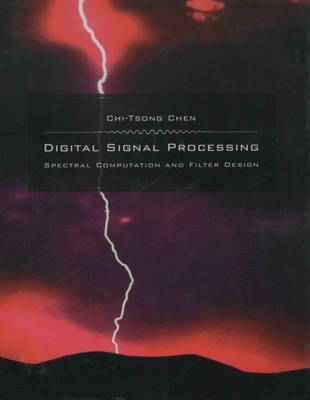
Digital Signal Processing: Spectral Computation and Filter Design
| AUTHOR | Chen, Chi-Tsong |
| PUBLISHER | Oxford University Press, USA (11/30/2000) |
| PRODUCT TYPE | Hardcover (Hardcover) |
Description
Designed for a first course in digital signal processing, Digital Signal Processing: Spectral Computation and Filter Design covers two major topics: the computation of frequency contents of signals and the design of digital filters. While it focuses on basic ideas and procedures and covers the standard topics in the field, this unique text distinguishes itself from competing texts by extensively employing the fast Fourier transform (FFT). Part 1: Spectral Computation deals with continuous-time (CT), discrete-time (DT), and digital signals; CT and DT Fourier series (frequency components); CT and DT Fourier transforms (frequency spectra); and discrete Fourier transform (DFT) and fast Fourier transform (FFT). Part 2: Digital Filter Design discusses linear time-invariant lumped systems; ideal and practical digital filters; design of FIR digital filters; design of IIR filters; and structures of digital filters. Digital Signal Processing covers numerous topics not found in similar texts. It:
- Establishes a simplified version of the sampling theorem for periodic signals
- Uses FFT to compute frequency spectra of DT and CT signals and inverse FFT to compute DT and CT signals from their frequency spectra
- Employs FFT to compute the inverse z-transform
- Covers steady-state and transient responses of digital filters and gives an estimated time for a transient response to die out
- Gives a mathematical justification for using an antialiasing analog filter in digital signal processing
- Introduces a discrete least-squares method to design FIR filters
- Presents an analog bandstop transformation that yields better results than ones generated by MATLAB(R) Digital Signal Processing features careful definitions of all terminology and a wealth of examples and problems. All numerical examples and most end-of-chapter problems are simple enough to be solved analytically by hand; these results can then be compared with the computer-generated solutions. MATLAB(R) is an integral part of the text.
- Establishes a simplified version of the sampling theorem for periodic signals
- Uses FFT to compute frequency spectra of DT and CT signals and inverse FFT to compute DT and CT signals from their frequency spectra
- Employs FFT to compute the inverse z-transform
- Covers steady-state and transient responses of digital filters and gives an estimated time for a transient response to die out
- Gives a mathematical justification for using an antialiasing analog filter in digital signal processing
- Introduces a discrete least-squares method to design FIR filters
- Presents an analog bandstop transformation that yields better results than ones generated by MATLAB(R) Digital Signal Processing features careful definitions of all terminology and a wealth of examples and problems. All numerical examples and most end-of-chapter problems are simple enough to be solved analytically by hand; these results can then be compared with the computer-generated solutions. MATLAB(R) is an integral part of the text.
Show More
Product Format
Product Details
ISBN-13:
9780195136388
ISBN-10:
0195136381
Binding:
Hardback or Cased Book (Sewn)
Content Language:
English
More Product Details
Page Count:
464
Carton Quantity:
1
Product Dimensions:
7.78 x 1.03 x 9.56 inches
Weight:
2.18 pound(s)
Feature Codes:
Illustrated
Country of Origin:
JP
Subject Information
BISAC Categories
Technology & Engineering | Telecommunications
Technology & Engineering | Electronics - Digital
Technology & Engineering | Electrical
Dewey Decimal:
621.382
Library of Congress Control Number:
00027881
Descriptions, Reviews, Etc.
publisher marketing
Designed for a first course in digital signal processing, Digital Signal Processing: Spectral Computation and Filter Design covers two major topics: the computation of frequency contents of signals and the design of digital filters. While it focuses on basic ideas and procedures and covers the standard topics in the field, this unique text distinguishes itself from competing texts by extensively employing the fast Fourier transform (FFT). Part 1: Spectral Computation deals with continuous-time (CT), discrete-time (DT), and digital signals; CT and DT Fourier series (frequency components); CT and DT Fourier transforms (frequency spectra); and discrete Fourier transform (DFT) and fast Fourier transform (FFT). Part 2: Digital Filter Design discusses linear time-invariant lumped systems; ideal and practical digital filters; design of FIR digital filters; design of IIR filters; and structures of digital filters. Digital Signal Processing covers numerous topics not found in similar texts. It:
- Establishes a simplified version of the sampling theorem for periodic signals
- Uses FFT to compute frequency spectra of DT and CT signals and inverse FFT to compute DT and CT signals from their frequency spectra
- Employs FFT to compute the inverse z-transform
- Covers steady-state and transient responses of digital filters and gives an estimated time for a transient response to die out
- Gives a mathematical justification for using an antialiasing analog filter in digital signal processing
- Introduces a discrete least-squares method to design FIR filters
- Presents an analog bandstop transformation that yields better results than ones generated by MATLAB(R) Digital Signal Processing features careful definitions of all terminology and a wealth of examples and problems. All numerical examples and most end-of-chapter problems are simple enough to be solved analytically by hand; these results can then be compared with the computer-generated solutions. MATLAB(R) is an integral part of the text.
- Establishes a simplified version of the sampling theorem for periodic signals
- Uses FFT to compute frequency spectra of DT and CT signals and inverse FFT to compute DT and CT signals from their frequency spectra
- Employs FFT to compute the inverse z-transform
- Covers steady-state and transient responses of digital filters and gives an estimated time for a transient response to die out
- Gives a mathematical justification for using an antialiasing analog filter in digital signal processing
- Introduces a discrete least-squares method to design FIR filters
- Presents an analog bandstop transformation that yields better results than ones generated by MATLAB(R) Digital Signal Processing features careful definitions of all terminology and a wealth of examples and problems. All numerical examples and most end-of-chapter problems are simple enough to be solved analytically by hand; these results can then be compared with the computer-generated solutions. MATLAB(R) is an integral part of the text.
Show More
Author:
Chen, Chi-Tsong
CHI-TSONG CHEN is Professor of Electrical Engineering at the State University of New York at Stony Brook and a Fellow of the IEEE. He is the author of more than eighty technical articles and five books, including Digital Signal Processing (OUP, 2001) and Linear System Theory and Design, 3/e (OUP,
1999).
1999).
Show More
Your Price
$242.54