
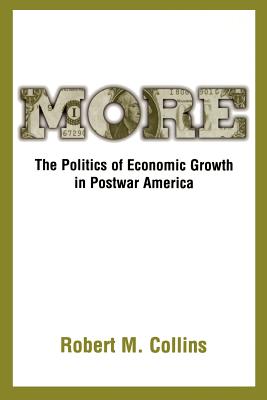
More: The Politics of Economic Growth in Postwar America
| AUTHOR | Collins, Robert M. |
| PUBLISHER | Oxford University Press (04/04/2002) |
| PRODUCT TYPE | Paperback (Paperback) |
Description
James Carville famously reminded Bill Clinton throughout 1992 that "it's the economy, stupid." Yet, for the last forty years, historians of modern America have ignored the economy to focus on cultural, social, and political themes, from the birth of modern feminism to the fall of the Berlin Wall. Now a scholar has stepped forward to place the economy back in its rightful place, at the center of his historical narrative.
In More, Robert M. Collins reexamines the history of the United States from Franklin Delano Roosevelt to Bill Clinton, focusing on the federal government's determined pursuit of economic growth. After tracing the emergence of growth as a priority during FDR's presidency, Collins explores the record of successive administrations, highlighting both their success in fostering growth and its partisan uses. Collins reveals that the obsession with growth appears not only as a matter of policy, but as an expression of Cold War ideology--both a means to pay for the arms build-up and proof of the superiority of the United States' market economy. But under Johnson, this enthusiasm sparked a crisis: spending on Vietnam unleashed runaway inflation, while the nation struggled with the moral consequences of its prosperity, reflected in books such as John Kenneth Galbraith's The Affluent Society and Rachel Carson's Silent Spring. More continues up to the end of the 1990s, as Collins explains the real impact of Reagan's policies and astutely assesses Clinton's "disciplined growthmanship," which combined deficit reduction and a relaxed but watchful monetary policy by the Federal Reserve.
Writing with eloquence and analytical clarity, Robert M. Collins offers a startlingly new framework for understanding the history of postwar America.
In More, Robert M. Collins reexamines the history of the United States from Franklin Delano Roosevelt to Bill Clinton, focusing on the federal government's determined pursuit of economic growth. After tracing the emergence of growth as a priority during FDR's presidency, Collins explores the record of successive administrations, highlighting both their success in fostering growth and its partisan uses. Collins reveals that the obsession with growth appears not only as a matter of policy, but as an expression of Cold War ideology--both a means to pay for the arms build-up and proof of the superiority of the United States' market economy. But under Johnson, this enthusiasm sparked a crisis: spending on Vietnam unleashed runaway inflation, while the nation struggled with the moral consequences of its prosperity, reflected in books such as John Kenneth Galbraith's The Affluent Society and Rachel Carson's Silent Spring. More continues up to the end of the 1990s, as Collins explains the real impact of Reagan's policies and astutely assesses Clinton's "disciplined growthmanship," which combined deficit reduction and a relaxed but watchful monetary policy by the Federal Reserve.
Writing with eloquence and analytical clarity, Robert M. Collins offers a startlingly new framework for understanding the history of postwar America.
Show More
Product Format
Product Details
ISBN-13:
9780195152630
ISBN-10:
0195152638
Binding:
Paperback or Softback (Trade Paperback (Us))
Content Language:
English
More Product Details
Page Count:
320
Carton Quantity:
26
Product Dimensions:
6.04 x 0.89 x 9.32 inches
Weight:
1.00 pound(s)
Country of Origin:
US
Subject Information
BISAC Categories
Political Science | Public Policy - Economic Policy
Political Science | United States - 20th Century
Accelerated Reader:
Reading Level:
0
Point Value:
0
Guided Reading Level:
Not Applicable
Dewey Decimal:
338.973
Descriptions, Reviews, Etc.
publisher marketing
James Carville famously reminded Bill Clinton throughout 1992 that "it's the economy, stupid." Yet, for the last forty years, historians of modern America have ignored the economy to focus on cultural, social, and political themes, from the birth of modern feminism to the fall of the Berlin Wall. Now a scholar has stepped forward to place the economy back in its rightful place, at the center of his historical narrative.
In More, Robert M. Collins reexamines the history of the United States from Franklin Delano Roosevelt to Bill Clinton, focusing on the federal government's determined pursuit of economic growth. After tracing the emergence of growth as a priority during FDR's presidency, Collins explores the record of successive administrations, highlighting both their success in fostering growth and its partisan uses. Collins reveals that the obsession with growth appears not only as a matter of policy, but as an expression of Cold War ideology--both a means to pay for the arms build-up and proof of the superiority of the United States' market economy. But under Johnson, this enthusiasm sparked a crisis: spending on Vietnam unleashed runaway inflation, while the nation struggled with the moral consequences of its prosperity, reflected in books such as John Kenneth Galbraith's The Affluent Society and Rachel Carson's Silent Spring. More continues up to the end of the 1990s, as Collins explains the real impact of Reagan's policies and astutely assesses Clinton's "disciplined growthmanship," which combined deficit reduction and a relaxed but watchful monetary policy by the Federal Reserve.
Writing with eloquence and analytical clarity, Robert M. Collins offers a startlingly new framework for understanding the history of postwar America.
In More, Robert M. Collins reexamines the history of the United States from Franklin Delano Roosevelt to Bill Clinton, focusing on the federal government's determined pursuit of economic growth. After tracing the emergence of growth as a priority during FDR's presidency, Collins explores the record of successive administrations, highlighting both their success in fostering growth and its partisan uses. Collins reveals that the obsession with growth appears not only as a matter of policy, but as an expression of Cold War ideology--both a means to pay for the arms build-up and proof of the superiority of the United States' market economy. But under Johnson, this enthusiasm sparked a crisis: spending on Vietnam unleashed runaway inflation, while the nation struggled with the moral consequences of its prosperity, reflected in books such as John Kenneth Galbraith's The Affluent Society and Rachel Carson's Silent Spring. More continues up to the end of the 1990s, as Collins explains the real impact of Reagan's policies and astutely assesses Clinton's "disciplined growthmanship," which combined deficit reduction and a relaxed but watchful monetary policy by the Federal Reserve.
Writing with eloquence and analytical clarity, Robert M. Collins offers a startlingly new framework for understanding the history of postwar America.
Show More
Author:
Collins, Robert M.
Robert M. Collins is Professor of History at the University of Missouri, Columbia, where he teaches recent U.S. history. He is the author of The Business Response to Keynes, 1929-1964. He lives in Columbia, Missouri.
Show More
Your Price
$93.06