
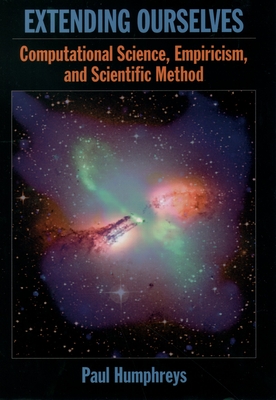
Extending Ourselves: Computational Science, Empiricism, and Scientific Method
| AUTHOR | Humphreys, Paul |
| PUBLISHER | Oxford University Press (07/22/2004) |
| PRODUCT TYPE | Hardcover (Hardcover) |
Description
Computational methods such as computer simulations, Monte Carlo methods, and agent-based modeling have become the dominant techniques in many areas of science. Extending Ourselves contains the first systematic philosophical account of these new methods, and how they require a different approach to scientific method. Paul Humphreys draws a parallel between the ways in which such computational methods have enhanced our abilities to mathematically model the world, and the more familiar ways in which scientific instruments have expanded our access to the empirical world. This expansion forms the basis for a new kind of empiricism, better suited to the needs of science than the older anthropocentric forms of empiricism. Human abilities are no longer the ultimate standard of epistemological correctness. Humphreys also includes arguments for the primacy of properties rather than objects, the need to consider technological constraints when appraising scientific methods, and a detailed account of how the path from computational template to scientific application is constructed. This last feature allows us to hold a form of selective realism in which anti-realist arguments based on formal reconstructions of theories can be avoided. One important consequence of the rise of computational methods is that the traditional organization of the sciences is being replaced by an organization founded on computational templates. Extending Ourselves will be of interest to philosophers of science, epistemologists, and to anyone interested in the role played by computers in modern science.
Show More
Product Format
Product Details
ISBN-13:
9780195158700
ISBN-10:
0195158709
Binding:
Hardback or Cased Book (Sewn)
Content Language:
English
More Product Details
Page Count:
182
Carton Quantity:
32
Product Dimensions:
6.48 x 0.74 x 9.58 inches
Weight:
0.95 pound(s)
Feature Codes:
Bibliography,
Index
Country of Origin:
US
Subject Information
BISAC Categories
Science | Philosophy & Social Aspects
Science | Epistemology
Science | Life Sciences - Botany
Dewey Decimal:
501.13
Library of Congress Control Number:
2003054939
Descriptions, Reviews, Etc.
publisher marketing
Computational methods such as computer simulations, Monte Carlo methods, and agent-based modeling have become the dominant techniques in many areas of science. Extending Ourselves contains the first systematic philosophical account of these new methods, and how they require a different approach to scientific method. Paul Humphreys draws a parallel between the ways in which such computational methods have enhanced our abilities to mathematically model the world, and the more familiar ways in which scientific instruments have expanded our access to the empirical world. This expansion forms the basis for a new kind of empiricism, better suited to the needs of science than the older anthropocentric forms of empiricism. Human abilities are no longer the ultimate standard of epistemological correctness. Humphreys also includes arguments for the primacy of properties rather than objects, the need to consider technological constraints when appraising scientific methods, and a detailed account of how the path from computational template to scientific application is constructed. This last feature allows us to hold a form of selective realism in which anti-realist arguments based on formal reconstructions of theories can be avoided. One important consequence of the rise of computational methods is that the traditional organization of the sciences is being replaced by an organization founded on computational templates. Extending Ourselves will be of interest to philosophers of science, epistemologists, and to anyone interested in the role played by computers in modern science.
Show More
List Price $67.00
Your Price
$66.33