
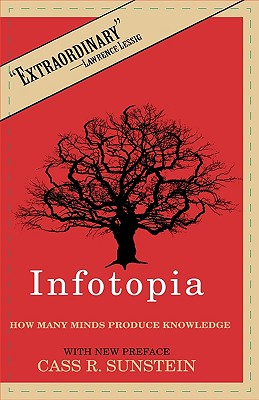
Infotopia: How Many Minds Produce Knowledge
| AUTHOR | Sunstein, Cass R. |
| PUBLISHER | Oxford University Press (08/24/2006) |
| PRODUCT TYPE | Hardcover (Hardcover) |
Description
The rise of the "information society" offers not only considerable peril but also great promise. Beset from all sides by a never-ending barrage of media, how can we ensure that the most accurate information emerges and is heeded? In this book, Cass R. Sunstein develops a deeply optimistic understanding of the human potential to pool information, and to use that knowledge to improve our lives. In an age of information overload, it is easy to fall back on our own prejudices and insulate ourselves with comforting opinions that reaffirm our core beliefs. Crowds quickly become mobs. The justification for the Iraq war, the collapse of Enron, the explosion of the space shuttle Columbia--all of these resulted from decisions made by leaders and groups trapped in "information cocoons," shielded from information at odds with their preconceptions. How can leaders and ordinary people challenge insular decision making and gain access to the sum of human knowledge? Stunning new ways to share and aggregate information, many Internet-based, are helping companies, schools, governments, and individuals not only to acquire, but also to create, ever-growing bodies of accurate knowledge. Through a ceaseless flurry of self-correcting exchanges, wikis, covering everything from politics and business plans to sports and science fiction subcultures, amass--and refine--information. Open-source software enables large numbers of people to participate in technological development. Prediction markets aggregate information in a way that allows companies, ranging from computer manufacturers to Hollywood studios, to make better decisions about product launches and office openings. Sunstein shows how people can assimilate aggregated information without succumbing to the dangers of the herd mentality--and when and why the new aggregation techniques are so astoundingly accurate. In a world where opinion and anecdote increasingly compete on equal footing with hard evidence, the on-line effort of many minds coming together might well provide the best path to infotopia.
Show More
Product Format
Product Details
ISBN-13:
9780195189285
ISBN-10:
0195189280
Binding:
Hardback or Cased Book (Sewn)
Content Language:
English
More Product Details
Page Count:
288
Carton Quantity:
22
Product Dimensions:
5.76 x 0.99 x 8.70 inches
Weight:
1.13 pound(s)
Feature Codes:
Bibliography,
Index,
Dust Cover,
Annotated,
Price on Product,
Table of Contents
Country of Origin:
GB
Subject Information
BISAC Categories
Computers | Information Technology
Computers | Media & the Law
Dewey Decimal:
303.483
Library of Congress Control Number:
2005036052
Descriptions, Reviews, Etc.
annotation
Sunstein develops a deeply optimistic understanding of the human potential to pool information, and to use that knowledge to improve lives without falling back on prejudices.
Show More
publisher marketing
The rise of the "information society" offers not only considerable peril but also great promise. Beset from all sides by a never-ending barrage of media, how can we ensure that the most accurate information emerges and is heeded? In this book, Cass R. Sunstein develops a deeply optimistic understanding of the human potential to pool information, and to use that knowledge to improve our lives. In an age of information overload, it is easy to fall back on our own prejudices and insulate ourselves with comforting opinions that reaffirm our core beliefs. Crowds quickly become mobs. The justification for the Iraq war, the collapse of Enron, the explosion of the space shuttle Columbia--all of these resulted from decisions made by leaders and groups trapped in "information cocoons," shielded from information at odds with their preconceptions. How can leaders and ordinary people challenge insular decision making and gain access to the sum of human knowledge? Stunning new ways to share and aggregate information, many Internet-based, are helping companies, schools, governments, and individuals not only to acquire, but also to create, ever-growing bodies of accurate knowledge. Through a ceaseless flurry of self-correcting exchanges, wikis, covering everything from politics and business plans to sports and science fiction subcultures, amass--and refine--information. Open-source software enables large numbers of people to participate in technological development. Prediction markets aggregate information in a way that allows companies, ranging from computer manufacturers to Hollywood studios, to make better decisions about product launches and office openings. Sunstein shows how people can assimilate aggregated information without succumbing to the dangers of the herd mentality--and when and why the new aggregation techniques are so astoundingly accurate. In a world where opinion and anecdote increasingly compete on equal footing with hard evidence, the on-line effort of many minds coming together might well provide the best path to infotopia.
Show More
Author:
Sunstein, Cass R.
Cass R. Sunstein is Robert Walmsley University Professor at Harvard University, Massachusetts. From 2009 to 2012, he was Administrator of the White House Office of Information and Regulatory Affairs. He is the founder and director of the Program on Behavioral Economics and Public Policy at Harvard Law School. Mr Sunstein is author of many articles and books, including the best-selling Nudge: Improving Decisions about Health, Wealth, and Happiness (with Richard H. Thaler, 2008), Simpler: The Future of Government (2013), Why Nudge? (2014), Conspiracy Theories and Other Dangerous Ideas (2014), Wiser: Beyond Groupthink to Make Groups Smarter (2014), Valuing Life: Humanizing the Regulatory State (2014), Choosing Not to Choose: Understanding the Value of Choice (2015) and Constitutional Personae: Heroes, Soldiers, Minimalists, and Mutes (2015).
Show More
List Price $89.00
Your Price
$88.11