
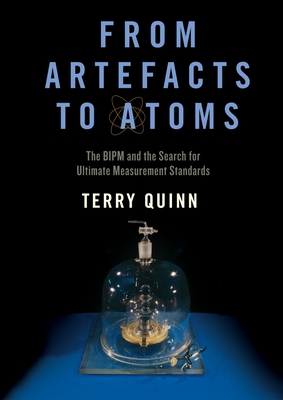
From Artefacts to Atoms: The Bipm and the Search for Ultimate Measurement Standards
| AUTHOR | Quinn, Terry |
| PUBLISHER | Oxford University Press (11/04/2011) |
| PRODUCT TYPE | Hardcover (Hardcover) |
The International Bureau of Weights and Measures (BIPM) is currently implementing the greatest change ever in the world's system of weights and measures -- it is redefining the kilogram, the final artefact standard, and reorganizing the system of international units. This book tells the inside story of what led to these changes, from the events surrounding the founding of the BIPM in 1875 -- a landmark in the history of international cooperation -- to the present. It traces not only the evolution of the science, but also the story of the key individuals and events.
The BIPM was the first international scientific laboratory. Founded in 1875 by the Metre Convention, its original tasks were to conserve the new international standards of the metre and the kilogram, to carry out calibrations for Member States and undertake research to advance measurement science. The book is based on the substantial archive of the BIPM which, from the very beginning, recounts the many discussions and arguments first as to whether and how such an institute should be created and in due course, how over the next one hundred and thirty years it should develop. Despite many national and personal rivalries, the institute actually created was admirably suited to its declared tasks. In the years and decades that followed, the scientific work of the small group of men who made up its first staff was of a very high order. One of the early Directors received the Nobel Prize for physics in 1920 for his discovery of invar. The international governing Board of the institute, the International Committee of Weights and Measures, has guided the institute from one charged with the conservation of the prototype artefacts to one now at the centre of world metrology and preparing for the redefinition of the last remaining artifact, the kilogram, in terms of a fixed value for one of the fundamental constants of physics, the Planck constant
The International Bureau of Weights and Measures (BIPM) is currently implementing the greatest change ever in the world's system of weights and measures -- it is redefining the kilogram, the final artefact standard, and reorganizing the system of international units. This book tells the inside story of what led to these changes, from the events surrounding the founding of the BIPM in 1875 -- a landmark in the history of international cooperation -- to the present. It traces not only the evolution of the science, but also the story of the key individuals and events.
The BIPM was the first international scientific laboratory. Founded in 1875 by the Metre Convention, its original tasks were to conserve the new international standards of the metre and the kilogram, to carry out calibrations for Member States and undertake research to advance measurement science. The book is based on the substantial archive of the BIPM which, from the very beginning, recounts the many discussions and arguments first as to whether and how such an institute should be created and in due course, how over the next one hundred and thirty years it should develop. Despite many national and personal rivalries, the institute actually created was admirably suited to its declared tasks. In the years and decades that followed, the scientific work of the small group of men who made up its first staff was of a very high order. One of the early Directors received the Nobel Prize for physics in 1920 for his discovery of invar. The international governing Board of the institute, the International Committee of Weights and Measures, has guided the institute from one charged with the conservation of the prototype artefacts to one now at the centre of world metrology and preparing for the redefinition of the last remaining artifact, the kilogram, in terms of a fixed value for one of the fundamental constants of physics, the Planck constant