
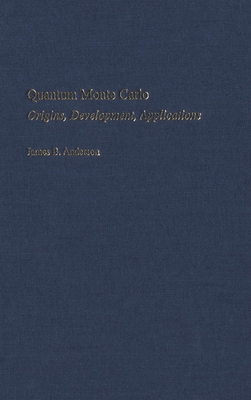
Quantum Monte Carlo: Origins, Development, Applications
| AUTHOR | Anderson, James B. |
| PUBLISHER | Oxford University Press, USA (06/18/2007) |
| PRODUCT TYPE | Hardcover (Hardcover) |
Description
Monte Carlo methods are a class of computational algorithms for simulating the behavior of a wide range of various physical and mathematical systems (with many variables). Their utility has increased with general availability of fast computers, and new applications are continually forthcoming. The basic concepts of Monte Carlo are both simple and straightforward and rooted in statistics and probability theory, their defining characteristic being that the methodology relies on random or pseudo-random sequences of numbers. It is a technique of numerical analysis based on the approximate solution of a problem using repeated sampling experiments and observing the proportion of times a given property is satisfied.
The term Monte Carlo was first used to describe calculational methods based on chance in the 1940s, but the methods themselves preceded the term by as much as a century. Quantum Monte Carlo (QMC) first appeared in 1982 and similarly was preceded by development of the related calculational methodology. The success of QMC methods over the past few decades has been remarkable, and this book will clearly demonstrate that success in its discussion of applications. For isolated molecules, the basic material of chemistry, QMC methods have produced exact solutions of the Schroedinger equation for very small systems and the most accurate solutions available for very large systems. The range of applications is impressive: folding of protein molecules, interactions in liquids, structure modeling in crystals and enzymes, quantum dots, designing heat shields and aerodynamic forms, architecture, design, business and economics, and even cinema and video games (3D modeling).
This book takes a similar approach to Henry Schaefers classic book Quantum Chemistry (OUP, 1984 now a Dover edition), collecting summaries of some of the most important papers in the quantum Monte Carlo literature, tying everything together with analysis and discussion of applications. Quantum Monte Carlo is a reference book for quantum Monte Carlo applications, belonging near the desk of every quantum chemist, physicist, and a wide range of scientists and engineers across many disciplines, destined to become a classic.
The term Monte Carlo was first used to describe calculational methods based on chance in the 1940s, but the methods themselves preceded the term by as much as a century. Quantum Monte Carlo (QMC) first appeared in 1982 and similarly was preceded by development of the related calculational methodology. The success of QMC methods over the past few decades has been remarkable, and this book will clearly demonstrate that success in its discussion of applications. For isolated molecules, the basic material of chemistry, QMC methods have produced exact solutions of the Schroedinger equation for very small systems and the most accurate solutions available for very large systems. The range of applications is impressive: folding of protein molecules, interactions in liquids, structure modeling in crystals and enzymes, quantum dots, designing heat shields and aerodynamic forms, architecture, design, business and economics, and even cinema and video games (3D modeling).
This book takes a similar approach to Henry Schaefers classic book Quantum Chemistry (OUP, 1984 now a Dover edition), collecting summaries of some of the most important papers in the quantum Monte Carlo literature, tying everything together with analysis and discussion of applications. Quantum Monte Carlo is a reference book for quantum Monte Carlo applications, belonging near the desk of every quantum chemist, physicist, and a wide range of scientists and engineers across many disciplines, destined to become a classic.
Show More
Product Format
Product Details
ISBN-13:
9780195310108
ISBN-10:
0195310101
Binding:
Hardback or Cased Book (Sewn)
Content Language:
English
More Product Details
Page Count:
198
Carton Quantity:
34
Product Dimensions:
5.74 x 0.72 x 8.55 inches
Weight:
0.81 pound(s)
Feature Codes:
Index
Country of Origin:
US
Subject Information
BISAC Categories
Science | Physics - Quantum Theory
Dewey Decimal:
530.120
Library of Congress Control Number:
2006040145
Descriptions, Reviews, Etc.
publisher marketing
Monte Carlo methods are a class of computational algorithms for simulating the behavior of a wide range of various physical and mathematical systems (with many variables). Their utility has increased with general availability of fast computers, and new applications are continually forthcoming. The basic concepts of Monte Carlo are both simple and straightforward and rooted in statistics and probability theory, their defining characteristic being that the methodology relies on random or pseudo-random sequences of numbers. It is a technique of numerical analysis based on the approximate solution of a problem using repeated sampling experiments and observing the proportion of times a given property is satisfied.
The term Monte Carlo was first used to describe calculational methods based on chance in the 1940s, but the methods themselves preceded the term by as much as a century. Quantum Monte Carlo (QMC) first appeared in 1982 and similarly was preceded by development of the related calculational methodology. The success of QMC methods over the past few decades has been remarkable, and this book will clearly demonstrate that success in its discussion of applications. For isolated molecules, the basic material of chemistry, QMC methods have produced exact solutions of the Schroedinger equation for very small systems and the most accurate solutions available for very large systems. The range of applications is impressive: folding of protein molecules, interactions in liquids, structure modeling in crystals and enzymes, quantum dots, designing heat shields and aerodynamic forms, architecture, design, business and economics, and even cinema and video games (3D modeling).
This book takes a similar approach to Henry Schaefers classic book Quantum Chemistry (OUP, 1984 now a Dover edition), collecting summaries of some of the most important papers in the quantum Monte Carlo literature, tying everything together with analysis and discussion of applications. Quantum Monte Carlo is a reference book for quantum Monte Carlo applications, belonging near the desk of every quantum chemist, physicist, and a wide range of scientists and engineers across many disciplines, destined to become a classic.
The term Monte Carlo was first used to describe calculational methods based on chance in the 1940s, but the methods themselves preceded the term by as much as a century. Quantum Monte Carlo (QMC) first appeared in 1982 and similarly was preceded by development of the related calculational methodology. The success of QMC methods over the past few decades has been remarkable, and this book will clearly demonstrate that success in its discussion of applications. For isolated molecules, the basic material of chemistry, QMC methods have produced exact solutions of the Schroedinger equation for very small systems and the most accurate solutions available for very large systems. The range of applications is impressive: folding of protein molecules, interactions in liquids, structure modeling in crystals and enzymes, quantum dots, designing heat shields and aerodynamic forms, architecture, design, business and economics, and even cinema and video games (3D modeling).
This book takes a similar approach to Henry Schaefers classic book Quantum Chemistry (OUP, 1984 now a Dover edition), collecting summaries of some of the most important papers in the quantum Monte Carlo literature, tying everything together with analysis and discussion of applications. Quantum Monte Carlo is a reference book for quantum Monte Carlo applications, belonging near the desk of every quantum chemist, physicist, and a wide range of scientists and engineers across many disciplines, destined to become a classic.
Show More
List Price $105.00
Your Price
$103.95