
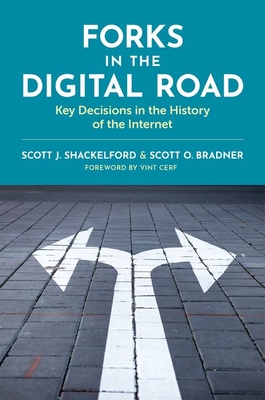
Forks in the Digital Road: Key Decisions in the History of the Internet
| AUTHOR | Bradner, Scott O.; Shackelford, Scott J.; Shackelford |
| PUBLISHER | Oxford University Press (05/07/2024) |
| PRODUCT TYPE | Paperback (Paperback) |
Description
Fifty years ago, a UCLA computer science professor and his student sent the first electronic message over a network called ARPANET, a predecessor to the Internet. The intended message, the word "login", was truncated in a computer crash to "lo." Digital infrastructure has made significant advances since then, but key decision points in the history of the Internet continue to reverberate today and have done much to shape not only cyberspace, but the twenty-first century. In Forks in the Digital Road, Scott J. Shackelford and Scott O. Bradner revisit the key decision points in the history of cybersecurity and Internet governance, revealing the alternative paths or "forks" that existed at the time and addressing the question of "what if?". What if encryption was built into the Internet's architecture from the beginning? What if Section 230, which shields Internet platforms from civil liability, had taken a different form? What if Cerf and Kahn had structured TCP/IP in another way? What if Tim Berners-Lee had taken the advice of counsel and patented the World Wide Web? And what if the US government had not gotten directly involved with Internet governance in 1998, or elected not to help launch a new era of cyber conflict in 2006? Shackelford and Bradner answer these questions, and many more. They explain how things might have been different if other paths had been followed and offer practical ideas to help build a new vision of cyberspace that is as secure, private, efficient, and fun as possible. At a time when the future of cyberspace has never been more in doubt--with the potential for a new Digital Cold War, or even a "splinternet" having the potential to fracture cyberspace into a series of national-level intranets in the wake of the war in Ukraine--the time is ripe to take both a look back, and ahead.
Show More
Product Format
Product Details
ISBN-13:
9780197617779
ISBN-10:
0197617778
Binding:
Paperback or Softback (Trade Paperback (Us))
Content Language:
English
More Product Details
Page Count:
232
Carton Quantity:
30
Product Dimensions:
6.20 x 0.70 x 9.30 inches
Weight:
0.80 pound(s)
Feature Codes:
Bibliography,
Index
Country of Origin:
US
Subject Information
BISAC Categories
Education | General
Education | Political Process - Media & Internet
Education | Public Policy - Science & Technology Policy
Dewey Decimal:
004.678
Library of Congress Control Number:
2023044276
Descriptions, Reviews, Etc.
publisher marketing
Fifty years ago, a UCLA computer science professor and his student sent the first electronic message over a network called ARPANET, a predecessor to the Internet. The intended message, the word "login", was truncated in a computer crash to "lo." Digital infrastructure has made significant advances since then, but key decision points in the history of the Internet continue to reverberate today and have done much to shape not only cyberspace, but the twenty-first century. In Forks in the Digital Road, Scott J. Shackelford and Scott O. Bradner revisit the key decision points in the history of cybersecurity and Internet governance, revealing the alternative paths or "forks" that existed at the time and addressing the question of "what if?". What if encryption was built into the Internet's architecture from the beginning? What if Section 230, which shields Internet platforms from civil liability, had taken a different form? What if Cerf and Kahn had structured TCP/IP in another way? What if Tim Berners-Lee had taken the advice of counsel and patented the World Wide Web? And what if the US government had not gotten directly involved with Internet governance in 1998, or elected not to help launch a new era of cyber conflict in 2006? Shackelford and Bradner answer these questions, and many more. They explain how things might have been different if other paths had been followed and offer practical ideas to help build a new vision of cyberspace that is as secure, private, efficient, and fun as possible. At a time when the future of cyberspace has never been more in doubt--with the potential for a new Digital Cold War, or even a "splinternet" having the potential to fracture cyberspace into a series of national-level intranets in the wake of the war in Ukraine--the time is ripe to take both a look back, and ahead.
Show More
List Price $27.95
Your Price
$27.67