
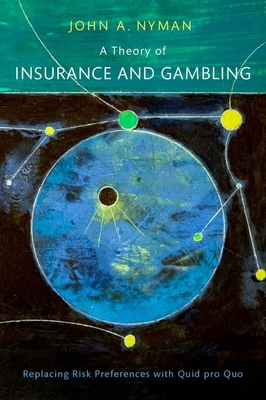
A Theory of Insurance and Gambling: Replacing Risk Preferences with Quid Pro Quo
| AUTHOR | Nyman, John A. |
| PUBLISHER | Oxford University Press (02/01/2024) |
| PRODUCT TYPE | Hardcover (Hardcover) |
Description
In 1948, Milton Friedman and L. J. Savage suggested that risk preferences explain the demand for insurance and gambling--a theory that is still almost universally accepted by economists today. If you were to ask almost any economist why people purchase insurance, they would say it is because most people are "risk averse," or equivalently, "prefer certainty of losses." If asked to explain why people gamble, they would say it is because some people are "risk seekers." In A Theory of Insurance and Gambling, John A. Nyman critiques this approach and proposes a new theory of the motivations for insurance and gambling. He argues that demand for insurance and gambling is best understood by focusing not on risk preferences, but on the income transfer, the states of the world that trigger the income transfer, and the value of the income in those states. In other words, insurance is motivated by a preference to transfer income to future states of the world where income is more valuable. Gambling, on the other hand, is motivated by a preference to transfer income to future states of the world where additional income is less costly to obtain. Nyman ultimately seeks to reorient how economists think about insurance and gambling by moving away from seeing uncertainty as a negative motivating factor to simply a mechanical feature that allows for the augmentation of income and consumption. He moves away from biased models that ignore income effects and state dependency when evaluating the benefits from insurance and gambling, and away from preferences regarding risk toward the desire to obtain additional future income. Presenting the case that risk preferences do not motivate demand for insurance or gambling, A Theory of Insurance and Gambling calls into question a fundamental tenet of economic thinking.
Show More
Product Format
Product Details
ISBN-13:
9780197687925
ISBN-10:
019768792X
Binding:
Hardback or Cased Book (Sewn)
Content Language:
English
More Product Details
Page Count:
272
Carton Quantity:
24
Product Dimensions:
6.40 x 1.40 x 8.90 inches
Weight:
1.10 pound(s)
Feature Codes:
Bibliography,
Index,
Illustrated
Country of Origin:
US
Subject Information
BISAC Categories
Business & Economics | Economics - Theory
Business & Economics | Insurance - Risk Assessment & Management
Dewey Decimal:
368
Library of Congress Control Number:
2023045395
Descriptions, Reviews, Etc.
publisher marketing
In 1948, Milton Friedman and L. J. Savage suggested that risk preferences explain the demand for insurance and gambling--a theory that is still almost universally accepted by economists today. If you were to ask almost any economist why people purchase insurance, they would say it is because most people are "risk averse," or equivalently, "prefer certainty of losses." If asked to explain why people gamble, they would say it is because some people are "risk seekers." In A Theory of Insurance and Gambling, John A. Nyman critiques this approach and proposes a new theory of the motivations for insurance and gambling. He argues that demand for insurance and gambling is best understood by focusing not on risk preferences, but on the income transfer, the states of the world that trigger the income transfer, and the value of the income in those states. In other words, insurance is motivated by a preference to transfer income to future states of the world where income is more valuable. Gambling, on the other hand, is motivated by a preference to transfer income to future states of the world where additional income is less costly to obtain. Nyman ultimately seeks to reorient how economists think about insurance and gambling by moving away from seeing uncertainty as a negative motivating factor to simply a mechanical feature that allows for the augmentation of income and consumption. He moves away from biased models that ignore income effects and state dependency when evaluating the benefits from insurance and gambling, and away from preferences regarding risk toward the desire to obtain additional future income. Presenting the case that risk preferences do not motivate demand for insurance or gambling, A Theory of Insurance and Gambling calls into question a fundamental tenet of economic thinking.
Show More
List Price $95.00
Your Price
$94.05