
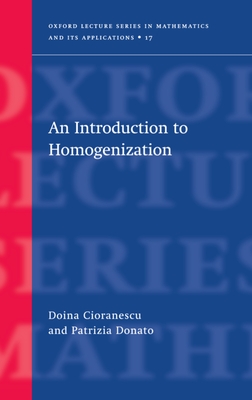
An Introduction to Homogenization
| AUTHOR | Cioranescu, Doina; Cioranescu, D.; Cioranescu, Diona et al. |
| PUBLISHER | OUP Oxford (02/24/2000) |
| PRODUCT TYPE | Hardcover (Hardcover) |
Description
Composite materials are widely used in industry and include such well known examples as superconductors and optical fibers. However, modeling these materials is difficult, since they often has different properties at different points. The mathematical theory of homogenization is designed to handle this problem. The theory uses an idealized homogenous material to model a real composite while taking into account the microscopic structure. This introduction to homogenization theory develops the natural framework of the theory with four chapters on variational methods for partial differential equations. It then discusses the homogenization of several kinds of second-order boundary value problems. It devotes separate chapters to the classical examples of stead and non-steady heat equations, the wave equation, and the linearized system of elasticity. It includes numerous illustrations and examples.
Show More
Product Format
Product Details
ISBN-13:
9780198565543
ISBN-10:
0198565542
Binding:
Hardback or Cased Book (Sewn)
Content Language:
English
More Product Details
Page Count:
272
Carton Quantity:
30
Product Dimensions:
6.14 x 0.63 x 9.21 inches
Weight:
1.23 pound(s)
Feature Codes:
Bibliography,
Index,
Illustrated
Country of Origin:
US
Subject Information
BISAC Categories
Mathematics | Differential Equations - General
Mathematics | Calculus
Mathematics | Mathematical Analysis
Dewey Decimal:
515.35
Library of Congress Control Number:
99033467
Descriptions, Reviews, Etc.
publisher marketing
Composite materials are widely used in industry and include such well known examples as superconductors and optical fibers. However, modeling these materials is difficult, since they often has different properties at different points. The mathematical theory of homogenization is designed to handle this problem. The theory uses an idealized homogenous material to model a real composite while taking into account the microscopic structure. This introduction to homogenization theory develops the natural framework of the theory with four chapters on variational methods for partial differential equations. It then discusses the homogenization of several kinds of second-order boundary value problems. It devotes separate chapters to the classical examples of stead and non-steady heat equations, the wave equation, and the linearized system of elasticity. It includes numerous illustrations and examples.
Show More
List Price $205.00
Your Price
$202.95