
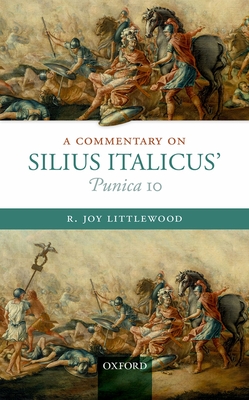
A Commentary on Silius Italicus' Punica 10
| AUTHOR | Littlewood, R. Joy |
| PUBLISHER | Oxford University Press, USA (05/23/2017) |
| PRODUCT TYPE | Hardcover (Hardcover) |
Description
The Battle of Cannae represents a conflict of mighty powers and a crushing defeat, notoriously the worst in Rome's history. Dawn on August 2, 216 BC, saw the armies of Rome and Carthage clash in what the participants hoped would be the decisive engagement for supremacy in Mediterranean trade and empire. Punica 10 opens with the final phase of the battle, when there lingered no hope of victory in the Roman ranks. The military narrative moves mercilessly through the aristeia and death of the heroic consul, Paulus, to the ghastly tableau of Roman defeat. But the mystique of Cannae lies in a paradox: that the army ignominiously vanquished emerges the ultimate victor. Although night falls on a battlefield littered with the wreckage of Rome's military might and a triumphant victor still unsated with Roman blood, the second half of the book unfolds a sequence of unexpected twists in the action which destabilize Hannibal's confidence and initiate acts of heroism inspiring fresh
resolution in the traumatized Romans. In one of Silius' finest books, the climactic sweep of his epic is enriched by intertextual allusions to Virgil's great narrative of epic closure: Aeneid 12. In contrast to her earlier commentary on Punica 7, which explores intertexts associated with Hannibal's desecration of rural Italy, R. Joy Littlewood's new commentary focuses on Silius' military narrative; the poetics of defeat with its imagery of shipwreck and the spectacle of death in the Roman amphitheatre. It aims to show how a poet with long experience in politics as a senior senator in the first century CE interpreted Rome's historic disaster and eventual triumph in the light of his own experiences of civil war and a swift succession of Roman emperors. Presented here alongside the Latin text and translation, and supplemented with plans of the battlefield, this commentary offers both philological and stylistic exegesis alongside historical analysis and up to date literary criticism. It is accompanied by an extended introduction including analyses of Silius' adaptation of Livy's Cannae narrative, of the contrasting moral strengths of his three Roman heroes, and of the ideas
contained in the intertextually rich, exemplary epigram which closes Book 10.
resolution in the traumatized Romans. In one of Silius' finest books, the climactic sweep of his epic is enriched by intertextual allusions to Virgil's great narrative of epic closure: Aeneid 12. In contrast to her earlier commentary on Punica 7, which explores intertexts associated with Hannibal's desecration of rural Italy, R. Joy Littlewood's new commentary focuses on Silius' military narrative; the poetics of defeat with its imagery of shipwreck and the spectacle of death in the Roman amphitheatre. It aims to show how a poet with long experience in politics as a senior senator in the first century CE interpreted Rome's historic disaster and eventual triumph in the light of his own experiences of civil war and a swift succession of Roman emperors. Presented here alongside the Latin text and translation, and supplemented with plans of the battlefield, this commentary offers both philological and stylistic exegesis alongside historical analysis and up to date literary criticism. It is accompanied by an extended introduction including analyses of Silius' adaptation of Livy's Cannae narrative, of the contrasting moral strengths of his three Roman heroes, and of the ideas
contained in the intertextually rich, exemplary epigram which closes Book 10.
Show More
Product Format
Product Details
ISBN-13:
9780198713814
ISBN-10:
0198713819
Binding:
Hardback or Cased Book (Sewn)
Content Language:
English
More Product Details
Page Count:
352
Carton Quantity:
1
Product Dimensions:
5.40 x 1.00 x 8.60 inches
Weight:
1.15 pound(s)
Feature Codes:
Bibliography,
Index,
Illustrated
Country of Origin:
GB
Subject Information
BISAC Categories
Literary Collections | Ancient, Classical & Medieval
Literary Collections | Ancient - Rome
Literary Collections | General
Dewey Decimal:
873.01
Library of Congress Control Number:
2016936820
Descriptions, Reviews, Etc.
publisher marketing
The Battle of Cannae represents a conflict of mighty powers and a crushing defeat, notoriously the worst in Rome's history. Dawn on August 2, 216 BC, saw the armies of Rome and Carthage clash in what the participants hoped would be the decisive engagement for supremacy in Mediterranean trade and empire. Punica 10 opens with the final phase of the battle, when there lingered no hope of victory in the Roman ranks. The military narrative moves mercilessly through the aristeia and death of the heroic consul, Paulus, to the ghastly tableau of Roman defeat. But the mystique of Cannae lies in a paradox: that the army ignominiously vanquished emerges the ultimate victor. Although night falls on a battlefield littered with the wreckage of Rome's military might and a triumphant victor still unsated with Roman blood, the second half of the book unfolds a sequence of unexpected twists in the action which destabilize Hannibal's confidence and initiate acts of heroism inspiring fresh
resolution in the traumatized Romans. In one of Silius' finest books, the climactic sweep of his epic is enriched by intertextual allusions to Virgil's great narrative of epic closure: Aeneid 12. In contrast to her earlier commentary on Punica 7, which explores intertexts associated with Hannibal's desecration of rural Italy, R. Joy Littlewood's new commentary focuses on Silius' military narrative; the poetics of defeat with its imagery of shipwreck and the spectacle of death in the Roman amphitheatre. It aims to show how a poet with long experience in politics as a senior senator in the first century CE interpreted Rome's historic disaster and eventual triumph in the light of his own experiences of civil war and a swift succession of Roman emperors. Presented here alongside the Latin text and translation, and supplemented with plans of the battlefield, this commentary offers both philological and stylistic exegesis alongside historical analysis and up to date literary criticism. It is accompanied by an extended introduction including analyses of Silius' adaptation of Livy's Cannae narrative, of the contrasting moral strengths of his three Roman heroes, and of the ideas
contained in the intertextually rich, exemplary epigram which closes Book 10.
resolution in the traumatized Romans. In one of Silius' finest books, the climactic sweep of his epic is enriched by intertextual allusions to Virgil's great narrative of epic closure: Aeneid 12. In contrast to her earlier commentary on Punica 7, which explores intertexts associated with Hannibal's desecration of rural Italy, R. Joy Littlewood's new commentary focuses on Silius' military narrative; the poetics of defeat with its imagery of shipwreck and the spectacle of death in the Roman amphitheatre. It aims to show how a poet with long experience in politics as a senior senator in the first century CE interpreted Rome's historic disaster and eventual triumph in the light of his own experiences of civil war and a swift succession of Roman emperors. Presented here alongside the Latin text and translation, and supplemented with plans of the battlefield, this commentary offers both philological and stylistic exegesis alongside historical analysis and up to date literary criticism. It is accompanied by an extended introduction including analyses of Silius' adaptation of Livy's Cannae narrative, of the contrasting moral strengths of his three Roman heroes, and of the ideas
contained in the intertextually rich, exemplary epigram which closes Book 10.
Show More
List Price $135.00
Your Price
$133.65