
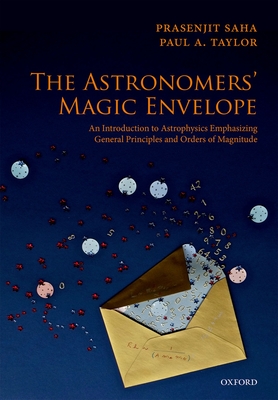
The Astronomers' Magic Envelope: An Introduction to Astrophysics Emphasizing General Principles and Orders of Magnitude
| AUTHOR | Saha, Taylor; Saha, Taylor; Saha, Taylor et al. |
| PUBLISHER | Oxford University Press (07/24/2018) |
| PRODUCT TYPE | Paperback (Paperback) |
Description
Working physicists, and especially astrophysicists, value a good back-of-the-envelope' calculation, meaning a short, elegant computation or argument that starts from general principles and leads to an interesting result. This book guides students on how to understand astrophysics using general principles and concise calculations -- endeavouring to be elegant where possible and using short computer programs where necessary. The material proceeds in approximate historical order. The book begins with the Enlightenment-era insight that the orbits of the planets is easy, but the orbit of the Moon is a real headache, and continues to deterministic chaos. This is followed by a chapter on spacetime and black holes. Four chapters reveal how microphysics, especially quantum mechanics, allow us to understand how stars work. The last two chapters are about cosmology, bringing us to 21st-century developments on the microwave background and gravitational waves.
Show More
Product Format
Product Details
ISBN-13:
9780198816478
ISBN-10:
0198816472
Binding:
Paperback or Softback (Trade Paperback (Us))
Content Language:
English
More Product Details
Page Count:
144
Carton Quantity:
23
Product Dimensions:
6.70 x 0.30 x 9.60 inches
Weight:
0.65 pound(s)
Country of Origin:
GB
Subject Information
BISAC Categories
Science | Physics - Astrophysics
Science | Space Science - Cosmology
Science | Space Science - Astronomy
Descriptions, Reviews, Etc.
publisher marketing
Working physicists, and especially astrophysicists, value a good back-of-the-envelope' calculation, meaning a short, elegant computation or argument that starts from general principles and leads to an interesting result. This book guides students on how to understand astrophysics using general principles and concise calculations -- endeavouring to be elegant where possible and using short computer programs where necessary. The material proceeds in approximate historical order. The book begins with the Enlightenment-era insight that the orbits of the planets is easy, but the orbit of the Moon is a real headache, and continues to deterministic chaos. This is followed by a chapter on spacetime and black holes. Four chapters reveal how microphysics, especially quantum mechanics, allow us to understand how stars work. The last two chapters are about cosmology, bringing us to 21st-century developments on the microwave background and gravitational waves.
Show More
List Price $37.99
Your Price
$37.61