
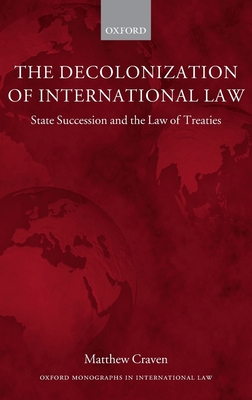
Decolonization of International Law: State Succession and the Law of Treaties
| AUTHOR | Craven, Matthew |
| PUBLISHER | OUP Oxford (03/01/2008) |
| PRODUCT TYPE | Hardcover (Hardcover) |
The issue of State Succession continues to be a vital, and complex, focal point for public international lawyers. The formative period of decolonization marked, for many, the time when international law 'came of age', when the promises of the UN Charter would be realized in an international community of sovereign peoples. Throughout the 1990s a series of territorial adjustments placed succession once again at the centre of international legal practice, in new contexts that went beyond the traditional model of decolonization: the disintegration of the Soviet Union, Yugoslavia and Czechoslovakia, and the unifications of Germany and Yemen brought to light the continued difficulties and inconsistencies in the core issues within the law of succession.
Why have attempts to codify the practice of succession met with so little success? Why has succession remained so problematic a feature of international law? This book argues that the answers to these questions lie in the political backdrop of decolonization and self-determination, that the tensions and ambiguities that run throughout succession are understood by looking at the relationship between discourses on state succession, decolonization, and imperial ambition within the framework of international law.
The issue of State Succession continues to be a vital, and complex, focal point for public international lawyers. The formative period of decolonization marked, for many, the time when international law 'came of age', when the promises of the UN Charter would be realized in an international community of sovereign peoples. Throughout the 1990s a series of territorial adjustments placed succession once again at the centre of international legal practice, in new contexts that went beyond the traditional model of decolonization: the disintegration of the Soviet Union, Yugoslavia and Czechoslovakia, and the unifications of Germany and Yemen brought to light the continued difficulties and inconsistencies in the core issues within the law of succession.
Why have attempts to codify the practice of succession met with so little success? Why has succession remained so problematic a feature of international law? This book argues that the answers to these questions lie in the political backdrop of decolonization and self-determination, that the tensions and ambiguities that run throughout succession are understood by looking at the relationship between discourses on state succession, decolonization, and imperial ambition within the framework of international law.