
ISBN 9780199263936 is currently unpriced. Please contact us for pricing.
Available options are listed below:
Available options are listed below:
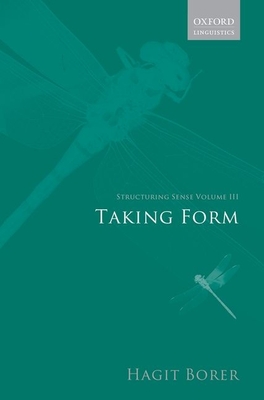
Structuring Sense: Volume III: Taking Form
| AUTHOR | Borer, Hagit |
| PUBLISHER | Oxford University Press, USA (12/15/2013) |
| PRODUCT TYPE | eBook (Other) |
Description
Structuring Sense explores the difference between words however defined and structures however constructed. It sets out to demonstrate over three volumes that the explanation of linguistic competence should be shifted from lexical entry to syntactic structure, from memory of words to manipulation of rules. Its reformulation of how grammar and lexicon interact has profound implications for linguistic, philosophical, and psychological theories about human mind and language. Hagit Borer departs from language specific constructional approaches and from lexicalist approaches to argue that universal hierarchical structures determine interpretation, and that language variation emerges from the morphological and phonological properties of inflectional material. Taking Form, the third and final volume of Structuring Sense, applies this radical approach to the construction of complex words. Integrating research in syntax and morphology, the author develops a new model of word formation, arguing that on the one hand the basic building blocks of language are rigid semantic and syntactic functions, while on the other hand they are roots, which in themselves are but packets of phonological information, and are devoid of both meaning and grammatical properties of any kind. Within such a model, syntactic category, syntactic selection and argument structure are all mediated through syntactic structures projected from rigid functions, or alternatively, constructed through general combinatorial principles of syntax, such as Chomsky's Merge. The meaning of 'words', in turn, does not involve the existence of lexemes, but rather the matching of a well-defined and phonologically articulated syntactic domain with conceptual Content, itself outside the
domain of language as such. In a departure from most current models of syntax but in line with many philosophical traditions, then, the Exo-Skeletal model partitions 'meaning' into formal functions, on the one hand, and Content, on the other hand. While the former are read off syntactico-semantic structures as is usually assumed, Content is crucially read off syntactico-phonological structures.
domain of language as such. In a departure from most current models of syntax but in line with many philosophical traditions, then, the Exo-Skeletal model partitions 'meaning' into formal functions, on the one hand, and Content, on the other hand. While the former are read off syntactico-semantic structures as is usually assumed, Content is crucially read off syntactico-phonological structures.
Show More
Product Format
Product Details
ISBN-13:
9780199263936
ISBN-10:
0199263930
Content Language:
English
More Product Details
Page Count:
704
Carton Quantity:
1
Country of Origin:
GB
Subject Information
BISAC Categories
Language Arts & Disciplines | Linguistics - Phonetics & Phonology
Language Arts & Disciplines | Grammar & Punctuation
Language Arts & Disciplines | Communication Studies
Dewey Decimal:
415
Descriptions, Reviews, Etc.
publisher marketing
Structuring Sense explores the difference between words however defined and structures however constructed. It sets out to demonstrate over three volumes that the explanation of linguistic competence should be shifted from lexical entry to syntactic structure, from memory of words to manipulation of rules. Its reformulation of how grammar and lexicon interact has profound implications for linguistic, philosophical, and psychological theories about human mind and language. Hagit Borer departs from language specific constructional approaches and from lexicalist approaches to argue that universal hierarchical structures determine interpretation, and that language variation emerges from the morphological and phonological properties of inflectional material. Taking Form, the third and final volume of Structuring Sense, applies this radical approach to the construction of complex words. Integrating research in syntax and morphology, the author develops a new model of word formation, arguing that on the one hand the basic building blocks of language are rigid semantic and syntactic functions, while on the other hand they are roots, which in themselves are but packets of phonological information, and are devoid of both meaning and grammatical properties of any kind. Within such a model, syntactic category, syntactic selection and argument structure are all mediated through syntactic structures projected from rigid functions, or alternatively, constructed through general combinatorial principles of syntax, such as Chomsky's Merge. The meaning of 'words', in turn, does not involve the existence of lexemes, but rather the matching of a well-defined and phonologically articulated syntactic domain with conceptual Content, itself outside the
domain of language as such. In a departure from most current models of syntax but in line with many philosophical traditions, then, the Exo-Skeletal model partitions 'meaning' into formal functions, on the one hand, and Content, on the other hand. While the former are read off syntactico-semantic structures as is usually assumed, Content is crucially read off syntactico-phonological structures.
domain of language as such. In a departure from most current models of syntax but in line with many philosophical traditions, then, the Exo-Skeletal model partitions 'meaning' into formal functions, on the one hand, and Content, on the other hand. While the former are read off syntactico-semantic structures as is usually assumed, Content is crucially read off syntactico-phonological structures.
Show More
Author:
Borer, Hagit
HAGIT BORER is a professor of linguistics at Queen Mary University, London, and also at the University of Southern California. She studied at the Massachusetts Institute of Technology, where she was a student of Noam Chomsky. She is now a world expert in the study of syntax, and her three-volume "Structuring Sense" is a standard work in the field. Originally from Israel, Hagit left to study in the USA in 1977 and became a US citizen in 1992; having become entirely disillusioned with Israeli politics as a student, she is now an activist for the rights of Arabs in the Israeli-Palestinian conflict.
Show More