
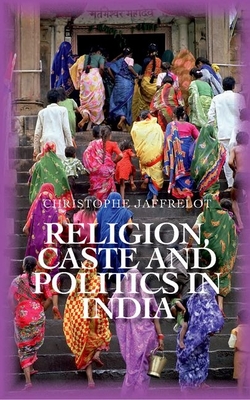
ISBN 9780199327515 is out of print and is currently unavailable, alternate formats (if applicable) are shown below.
Available options are listed below:
Available options are listed below:
Religion Caste and Politics in India (Out of print)
| AUTHOR | Jaffrelot, Christophe |
| PUBLISHER | Oxford University Press, USA (08/16/2011) |
| PRODUCT TYPE | Hardcover (Hardcover) |
Description
After Independence the Nehruvian approach to socialism in India rested upon three pillars: secularism and democracy in the political domain; state intervention in the economy; and diplomatic Non-Alignment mitigated by pro-Soviet leanings after the 1960s. These features defined the "Indian model," and even the country's political identity. From this starting point Christophe Jaffrelot explores the manner in which some of these dimensions have been transformed over the course of time, more especially since the 1980-90s. The world's largest democracy has sustained itself by making more room, not only for the vernacular politicians of the linguistic states, but also for Dalits and OBCs, at least after the Mandal Commission report. But the simultaneous--and related--rise of Hindu nationalism has put the minorities--and secularism--on the defensive, and in many ways the rule of law is on trial too. The liberalisaton of the economy has resulted in growth but not necessarily in development: while the new middle class is changing the face of urban India, the rural areas lag behind and inequalities have become more acute. India has also acquired a new global status, that of an emerging power seeking new political and economic partnerships in Asia and in the West, where the United States remains the first choice of the Indian middle class. The traditional Nehruvian system is giving way to a less cohesive but a more active India, a country that has already become what it is against all the odds. Christophe Jaffrelot tracks India's tumultuous journey of recent decades, exploring the role of religion, caste and politics in weaving the fabric of a modern democratic state.
Show More
Product Format
Product Details
ISBN-13:
9780199327515
ISBN-10:
0199327513
Binding:
Hardback or Cased Book (Sewn)
Content Language:
English
More Product Details
Page Count:
600
Carton Quantity:
1
Feature Codes:
Bibliography
Country of Origin:
US
Subject Information
BISAC Categories
Social Science | Regional Studies
Social Science | Religion, Politics & State
Social Science | Social Classes & Economic Disparity
Grade Level:
Post Graduate
and up
Dewey Decimal:
322.109
Descriptions, Reviews, Etc.
publisher marketing
After Independence the Nehruvian approach to socialism in India rested upon three pillars: secularism and democracy in the political domain; state intervention in the economy; and diplomatic Non-Alignment mitigated by pro-Soviet leanings after the 1960s. These features defined the "Indian model," and even the country's political identity. From this starting point Christophe Jaffrelot explores the manner in which some of these dimensions have been transformed over the course of time, more especially since the 1980-90s. The world's largest democracy has sustained itself by making more room, not only for the vernacular politicians of the linguistic states, but also for Dalits and OBCs, at least after the Mandal Commission report. But the simultaneous--and related--rise of Hindu nationalism has put the minorities--and secularism--on the defensive, and in many ways the rule of law is on trial too. The liberalisaton of the economy has resulted in growth but not necessarily in development: while the new middle class is changing the face of urban India, the rural areas lag behind and inequalities have become more acute. India has also acquired a new global status, that of an emerging power seeking new political and economic partnerships in Asia and in the West, where the United States remains the first choice of the Indian middle class. The traditional Nehruvian system is giving way to a less cohesive but a more active India, a country that has already become what it is against all the odds. Christophe Jaffrelot tracks India's tumultuous journey of recent decades, exploring the role of religion, caste and politics in weaving the fabric of a modern democratic state.
Show More
Author:
Jaffrelot, Christophe
Christophe Jaffrelot est diplome de l'Institut d'etudes politiques de Paris, de l'universite Paris I-Sorbonne et de l'Institut national des langues et civilisations orientales. Il est titulaire d un doctorat en sciences politiques, et est habilite a diriger des recherches a l'Institut d'etudes politiques de Paris ou il enseigne la politique de l Asie du sud. Directeur du CERI (Centre d'etudes et de recherches internationales), Christophe Jaffrelot est l'un des meilleurs specialistes de l'Asie du Sud en France. Christophe Jaffrelot est l'auteur de plusieurs ouvrages et essais - pour la plupart traduits dans plusieurs pays. Il a notamment publie "La Democratie en Inde" (Fayard, 1998), Le Pakistan (Fayard, 2000), "Inde: la democratie par la caste" (2005) et "L'Inde contemporaine" (Fayard, 2006).Photo: D.R.
Show More
List Price $90.00
Your Price
$89.10