
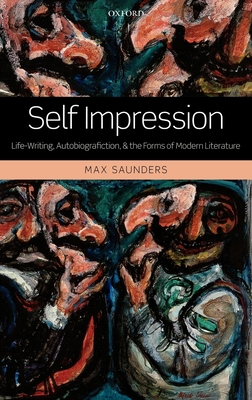
Self Impression: Life-Writing, Autobiografiction, and the Forms of Modern Literature
| AUTHOR | Saunders, Max |
| PUBLISHER | OUP Oxford (06/18/2010) |
| PRODUCT TYPE | Hardcover (Hardcover) |
Description
'I am aware that, once my pen intervenes, I can make whatever I like out of what I was.' Paul Valery, Moi. Modernism is often characterized as a movement of impersonality; a rejection of auto/biography. But most of the major works of European modernism and postmodernism engage in very profound and central ways with questions about life-writing. Max Saunders explores the ways in which modern writers from the 1870s to the 1930s experimented with forms of life-writing - biography, autobiography, memoir, diary, journal - increasingly for the purposes of fiction. He identifies a wave of new hybrid forms from the late nineteenth century and uses the term 'autobiografication' - discovered in a surprisingly early essay of 1906 - to provide a fresh perspective on turn-of-the-century literature, and to propose a radically new literary history of Modernism. Saunders offers a taxonomy of the extraordinary variety of experiments with life-writing, demonstrating how they arose in the nineteenth century as the pressures of secularization and psychological theory disturbed the categories of biography and autobiography, in works by authors such as Pater, Ruskin, Proust, 'Mark Rutherford', George Gissing, and A. C. Benson. He goes on to look at writers experimenting further with autobiografiction as Impressionism turns into Modernism., juxtaposing detailed and vivacious readings of key Modernist texts by Joyce, Stein, Pound, and Woolf, with explorations of the work of other authors - including H. G. Wells, Henry James, Joseph Conrad, Ford Madox Ford, and Wyndham Lewis - whose experiments with life-writing forms are no less striking. The book concludes with a consideration of the afterlife of these fascinating experiments in the postmodern literature of Nabokov, Lessing, and Byatt. Self Impression sheds light on a number of significant but under-theorized issues; the meanings of 'autobiographical', the generic implications of literary autobiography, and the intriguing relation between autobiography and fiction in the period.
Show More
Product Format
Product Details
ISBN-13:
9780199579761
ISBN-10:
0199579768
Binding:
Hardback or Cased Book (Unsewn / Adhesive Bound)
Content Language:
English
More Product Details
Page Count:
608
Carton Quantity:
14
Product Dimensions:
6.30 x 1.40 x 9.40 inches
Weight:
2.20 pound(s)
Feature Codes:
Bibliography,
Index,
Dust Cover,
Table of Contents,
Illustrated
Country of Origin:
US
Subject Information
BISAC Categories
Literary Criticism | European - General
Literary Criticism | Linguistics - General
Dewey Decimal:
809.935
Library of Congress Control Number:
2010922409
Descriptions, Reviews, Etc.
publisher marketing
'I am aware that, once my pen intervenes, I can make whatever I like out of what I was.' Paul Valery, Moi. Modernism is often characterized as a movement of impersonality; a rejection of auto/biography. But most of the major works of European modernism and postmodernism engage in very profound and central ways with questions about life-writing. Max Saunders explores the ways in which modern writers from the 1870s to the 1930s experimented with forms of life-writing - biography, autobiography, memoir, diary, journal - increasingly for the purposes of fiction. He identifies a wave of new hybrid forms from the late nineteenth century and uses the term 'autobiografication' - discovered in a surprisingly early essay of 1906 - to provide a fresh perspective on turn-of-the-century literature, and to propose a radically new literary history of Modernism. Saunders offers a taxonomy of the extraordinary variety of experiments with life-writing, demonstrating how they arose in the nineteenth century as the pressures of secularization and psychological theory disturbed the categories of biography and autobiography, in works by authors such as Pater, Ruskin, Proust, 'Mark Rutherford', George Gissing, and A. C. Benson. He goes on to look at writers experimenting further with autobiografiction as Impressionism turns into Modernism., juxtaposing detailed and vivacious readings of key Modernist texts by Joyce, Stein, Pound, and Woolf, with explorations of the work of other authors - including H. G. Wells, Henry James, Joseph Conrad, Ford Madox Ford, and Wyndham Lewis - whose experiments with life-writing forms are no less striking. The book concludes with a consideration of the afterlife of these fascinating experiments in the postmodern literature of Nabokov, Lessing, and Byatt. Self Impression sheds light on a number of significant but under-theorized issues; the meanings of 'autobiographical', the generic implications of literary autobiography, and the intriguing relation between autobiography and fiction in the period.
Show More
Author:
Saunders, Max
Max Saunders is Professor of English at King's College London, where he teaches nineteenth- and twentieth-century British, American and European literature. He is the author of the two-volume "Ford Madox Ford: A Dual Life" and the editor of Ford's "Selected Poems" and "War Prose", also available from NYU Press.
Richard Stang is professor emeritus of Washington University in St. Louis. His books include "The Theory of the Novel in England" and "Discussions of George Eliot".
Show More
List Price $185.00
Your Price
$183.15