
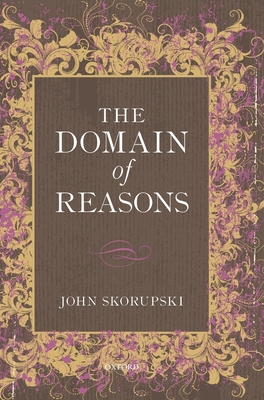
The Domain of Reasons
| AUTHOR | Skorupski, John |
| PUBLISHER | OUP Oxford (01/14/2011) |
| PRODUCT TYPE | Hardcover (Hardcover) |
Description
This book is about normativity and reasons. By the end, however, the subject becomes the relation between self, thought, and world. If we understand normativity, we are on the road to understanding this relation. John Skorupski argues that all normative properties are reducible to reason relations, so that the sole normative ingredient in any normative concept is the concept of a reason. This is a concept fundamental to all thought. It is pervasive (actions, beliefs, and sentiments all fall within its range), primitive (all other normative concepts are reducible to it), and constitutive of the idea of thought itself. Thinking is sensitivity to reasons. Thought in the full sense of autonomous cognition is possible only for a being sensitive to reasons and capable of deliberating about them. In Part II of the book Skorupski examines epistemic reasons, and shows that aprioricity, necessity, evidence, and probability, which may not seem to be normative at all, are in fact normative concepts analysable in terms of the concept of a reason. In Part III he shows the same for the concept of a person's good, and for moral concepts including the concept of a right. Part IV moves to the epistemology and metaphysics of reasons. When we make claims about reasons to believe, reasons to feel, or reasons to act we are asserting genuine propositions: judgeable, truth-apt contents. But these normative propositions must be distinguished from factual propositions, for they do not represent states of affairs. So Skorupski's ambitious theory of normativity has broad and deep implications for philosophy. It shows how reflection on the logic, epistemology, and ontology of reasons finally leads us to an account of the interplay of self, thought, and world.
Show More
Product Format
Product Details
ISBN-13:
9780199587636
ISBN-10:
0199587639
Binding:
Hardback or Cased Book (Unsewn / Adhesive Bound)
Content Language:
English
More Product Details
Page Count:
558
Carton Quantity:
14
Product Dimensions:
6.80 x 1.50 x 9.70 inches
Weight:
2.46 pound(s)
Feature Codes:
Bibliography,
Index,
Dust Cover,
Table of Contents,
Glossary
Country of Origin:
US
Subject Information
BISAC Categories
Philosophy | Ethics & Moral Philosophy
Philosophy | Metaphysics
Philosophy | Epistemology
Dewey Decimal:
121
Library of Congress Control Number:
2010933161
Descriptions, Reviews, Etc.
publisher marketing
This book is about normativity and reasons. By the end, however, the subject becomes the relation between self, thought, and world. If we understand normativity, we are on the road to understanding this relation. John Skorupski argues that all normative properties are reducible to reason relations, so that the sole normative ingredient in any normative concept is the concept of a reason. This is a concept fundamental to all thought. It is pervasive (actions, beliefs, and sentiments all fall within its range), primitive (all other normative concepts are reducible to it), and constitutive of the idea of thought itself. Thinking is sensitivity to reasons. Thought in the full sense of autonomous cognition is possible only for a being sensitive to reasons and capable of deliberating about them. In Part II of the book Skorupski examines epistemic reasons, and shows that aprioricity, necessity, evidence, and probability, which may not seem to be normative at all, are in fact normative concepts analysable in terms of the concept of a reason. In Part III he shows the same for the concept of a person's good, and for moral concepts including the concept of a right. Part IV moves to the epistemology and metaphysics of reasons. When we make claims about reasons to believe, reasons to feel, or reasons to act we are asserting genuine propositions: judgeable, truth-apt contents. But these normative propositions must be distinguished from factual propositions, for they do not represent states of affairs. So Skorupski's ambitious theory of normativity has broad and deep implications for philosophy. It shows how reflection on the logic, epistemology, and ontology of reasons finally leads us to an account of the interplay of self, thought, and world.
Show More
List Price $185.00
Your Price
$183.15