
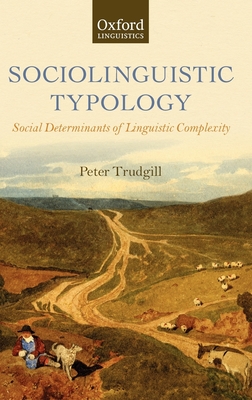
Sociolinguistic Typology: Social Determinants of Linguistic Complexity
| AUTHOR | Trudgill, Peter |
| PUBLISHER | OUP Oxford (12/17/2011) |
| PRODUCT TYPE | Hardcover (Hardcover) |
Description
Peter Trudgill looks at why human societies at different times and places produce different kinds of language. He considers how far social factors influence language structure and compares languages and dialects spoken across the globe, from Vietnam to Nigeria, Polynesia to Scandinavia, and from Canada to Amazonia. Modesty prevents Pennsylvanian Dutch Mennonites using the verb wotte ('want'); stratified society lies behind complicated Japanese honorifics; and a mountainous homeland suggests why speakers of Tibetan-Burmese Lahu have words for up there and down there. But culture and environment don't explain why Amazonian Jarawara needs three past tenses, nor why Nigerian Igbo can make do with eight adjectives, nor why most languages spoken in high altitudes do not exhibit an array of spatial demonstratives. Nor do they account for some languages changing faster than others or why some get more complex while others get simpler. The author looks at these and many other puzzles, exploring the social, linguistic, and other factors that might explain them and in the context of a huge range of languages and societies. Peter Trudgill writes readably, accessibly, and congenially. His book is jargon-free, informed by acute observation, and enlivened by argument: it will appeal to everyone with an interest in the interactions of language with culture, environment, and society.
Show More
Product Format
Product Details
ISBN-13:
9780199604340
ISBN-10:
0199604347
Binding:
Hardback or Cased Book (Sewn)
Content Language:
English
More Product Details
Page Count:
288
Carton Quantity:
28
Product Dimensions:
6.14 x 0.69 x 9.21 inches
Weight:
1.24 pound(s)
Feature Codes:
Bibliography,
Index
Country of Origin:
US
Subject Information
BISAC Categories
Language Arts & Disciplines | Linguistics - Sociolinguistics
Dewey Decimal:
306.44
Library of Congress Control Number:
2011276626
Descriptions, Reviews, Etc.
publisher marketing
Peter Trudgill looks at why human societies at different times and places produce different kinds of language. He considers how far social factors influence language structure and compares languages and dialects spoken across the globe, from Vietnam to Nigeria, Polynesia to Scandinavia, and from Canada to Amazonia. Modesty prevents Pennsylvanian Dutch Mennonites using the verb wotte ('want'); stratified society lies behind complicated Japanese honorifics; and a mountainous homeland suggests why speakers of Tibetan-Burmese Lahu have words for up there and down there. But culture and environment don't explain why Amazonian Jarawara needs three past tenses, nor why Nigerian Igbo can make do with eight adjectives, nor why most languages spoken in high altitudes do not exhibit an array of spatial demonstratives. Nor do they account for some languages changing faster than others or why some get more complex while others get simpler. The author looks at these and many other puzzles, exploring the social, linguistic, and other factors that might explain them and in the context of a huge range of languages and societies. Peter Trudgill writes readably, accessibly, and congenially. His book is jargon-free, informed by acute observation, and enlivened by argument: it will appeal to everyone with an interest in the interactions of language with culture, environment, and society.
Show More
Author:
Trudgill, Peter
Peter Trudgill is Professor of Sociolinguistics at the University of Agder. He has carried out research on dialects of English, Norwegian, Greek, Albanian and Spanish and has written and edited more than thirty books on sociolinguistics and dialectology including Sociolinguistic Variation and Change (2002), A Glossary of Sociolinguistics (2003) and New Dialect Formation (2004).
Show More
List Price $165.00
Your Price
$163.35