
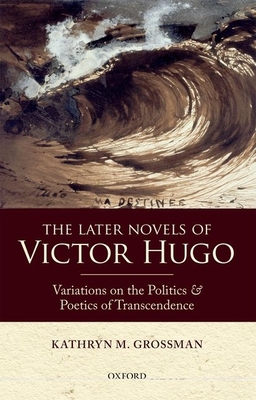
The Later Novels of Victor Hugo: Variations on the Politics and Poetics of Transcendence
| AUTHOR | Grossman, Kathryn M. |
| PUBLISHER | Oxford University Press, USA (05/23/2012) |
| PRODUCT TYPE | Hardcover (Hardcover) |
Description
This study places the last three novels of Victor Hugo's maturity - Les Travailleurs de la mer (1866), L'Homme qui rit (1869), and Quatrevingt-Treize (1874) - within the context of his artistic development after the success of Les Miserables (1862). By situating these historical narratives in relation to each other, to all of Hugo's previous fiction, and to a number of poetic and critical works published in exile and in the initial years of the Third Republic, it illuminates the final structural and thematic shifts from a poetics of harmony to one of transcendence. As in Les Miserables, the disharmony associated with social tumult, apocalyptic vision, and oxymoronic tensions provides an essential component of the later Hugo's Romantic sublime. Instead of merely capitalizing on the runaway success of Les Miserables by recycling its prominent features, however, each novel makes an original contribution to the political and aesthetic trajectory inscribed by the entire oeuvre. Each
testifies as well to the wizardry of Hugo's own 'special effects' that contribute to his story-telling genius. Such effects, especially the dizzying spatial optics and manipulation of temporal dimensions, function not as mere playful gimmicks or novelistic flourishes but as strategies for figuring and communicating the ideal, both political and artistic. The unique interplay of poetic and historical discourse in each text reconfigures our disordered experience of the world into something far more coherent a construction of meaning that strives to change perceptions and to promote social action.
testifies as well to the wizardry of Hugo's own 'special effects' that contribute to his story-telling genius. Such effects, especially the dizzying spatial optics and manipulation of temporal dimensions, function not as mere playful gimmicks or novelistic flourishes but as strategies for figuring and communicating the ideal, both political and artistic. The unique interplay of poetic and historical discourse in each text reconfigures our disordered experience of the world into something far more coherent a construction of meaning that strives to change perceptions and to promote social action.
Show More
Product Format
Product Details
ISBN-13:
9780199642953
ISBN-10:
0199642958
Binding:
Hardback or Cased Book (Unsewn / Adhesive Bound)
Content Language:
English
More Product Details
Page Count:
304
Carton Quantity:
1
Product Dimensions:
5.70 x 1.00 x 8.50 inches
Weight:
1.05 pound(s)
Feature Codes:
Bibliography,
Index,
Dust Cover,
Table of Contents
Country of Origin:
US
Subject Information
BISAC Categories
Literary Criticism | European - French
Dewey Decimal:
440
Descriptions, Reviews, Etc.
publisher marketing
This study places the last three novels of Victor Hugo's maturity - Les Travailleurs de la mer (1866), L'Homme qui rit (1869), and Quatrevingt-Treize (1874) - within the context of his artistic development after the success of Les Miserables (1862). By situating these historical narratives in relation to each other, to all of Hugo's previous fiction, and to a number of poetic and critical works published in exile and in the initial years of the Third Republic, it illuminates the final structural and thematic shifts from a poetics of harmony to one of transcendence. As in Les Miserables, the disharmony associated with social tumult, apocalyptic vision, and oxymoronic tensions provides an essential component of the later Hugo's Romantic sublime. Instead of merely capitalizing on the runaway success of Les Miserables by recycling its prominent features, however, each novel makes an original contribution to the political and aesthetic trajectory inscribed by the entire oeuvre. Each
testifies as well to the wizardry of Hugo's own 'special effects' that contribute to his story-telling genius. Such effects, especially the dizzying spatial optics and manipulation of temporal dimensions, function not as mere playful gimmicks or novelistic flourishes but as strategies for figuring and communicating the ideal, both political and artistic. The unique interplay of poetic and historical discourse in each text reconfigures our disordered experience of the world into something far more coherent a construction of meaning that strives to change perceptions and to promote social action.
testifies as well to the wizardry of Hugo's own 'special effects' that contribute to his story-telling genius. Such effects, especially the dizzying spatial optics and manipulation of temporal dimensions, function not as mere playful gimmicks or novelistic flourishes but as strategies for figuring and communicating the ideal, both political and artistic. The unique interplay of poetic and historical discourse in each text reconfigures our disordered experience of the world into something far more coherent a construction of meaning that strives to change perceptions and to promote social action.
Show More
Author:
Grossman, Kathryn M.
Kathryn M. Grossman is an associate professor of French at Pennsylvania State University.
Show More
List Price $155.00
Your Price
$153.45