
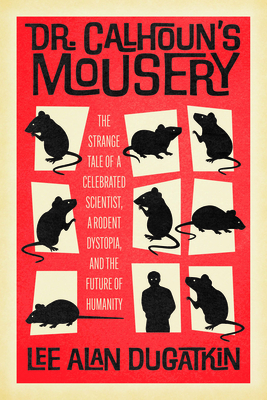
Dr. Calhoun's Mousery: The Strange Tale of a Celebrated Scientist, a Rodent Dystopia, and the Future of Humanity
| AUTHOR | Dugatkin, Lee Alan |
| PUBLISHER | University of Chicago Press (10/03/2024) |
| PRODUCT TYPE | Hardcover (Hardcover) |
Description
"Brilliant. . . . An absorbing read and a potent lesson in moral behavior--both of rodents and of humans."--Deborah Blum, Pulitzer Prize-winning author of The Poison Squad - "A fascinating read about an immensely influential scientist."--Robert M. Sapolsky, author of the New York Times-bestseller Determined - "Stimulating scientific history. . . . Colorful accounts. . . . This fascinates."--Publishers Weekly A bizarre and compelling biography of a scientist and his work, using rodent cities to question the potential catastrophes of human overpopulation. It was the strangest of experiments. What began as a utopian environment, where mice had sumptuous accommodations, had all the food and water they could want, and were free from disease and predators, turned into a mouse hell. Science writer and animal behaviorist Lee Alan Dugatkin introduces readers to the peculiar work of rodent researcher John Bumpass Calhoun. In this enthralling tale, Dugatkin shows how an ecologist-turned-psychologist-turned-futurist became a science rock star embedded in the culture of the 1960s and 1970s. As interest grew in his rodent cities, Calhoun was courted by city planners and his work was reflected in everything from Tom Wolfe's hard-hitting writing to the children's book Mrs. Frisby and the Rats of NIMH. He was invited to meetings with the Royal Society and the pope and taken seriously when he proposed a worldwide cybernetic brain--a decade before others made the internet a reality. Readers see how Calhoun's experiments--rodent apartment complexes like "Mouse Universe 25"--led to his concept of "behavioral sinks" with real effects on public policy discussions. Overpopulation in Calhoun's mouse (and rat) complexes led to the loss of sex drive, the absence of maternal care, and a class of automatons that included "the beautiful ones," who spent their time grooming themselves while shunning socialization. Calhoun--and those who followed his work--saw the collapse of this mouse population as a harbinger of the ill effects of an overpopulated human world. Drawing on previously unpublished archival research and interviews with Calhoun's family and former colleagues, Dugatkin offers a riveting account of an intriguing scientific figure. Considering Dr. Calhoun's experiments, he explores the changing nature of scientific research and delves into what the study of animal behavior can teach us about ourselves.
Show More
Product Format
Product Details
ISBN-13:
9780226827858
ISBN-10:
0226827852
Binding:
Hardback or Cased Book (Sewn)
Content Language:
English
More Product Details
Page Count:
240
Carton Quantity:
18
Product Dimensions:
5.80 x 1.10 x 8.60 inches
Weight:
1.20 pound(s)
Feature Codes:
Bibliography,
Index,
Price on Product,
Maps,
Illustrated
Country of Origin:
US
Subject Information
BISAC Categories
Science | Life Sciences - Zoology - Ethology (Animal Behavior)
Science | Science & Technology
Science | History
Dewey Decimal:
599.35
Library of Congress Control Number:
2024011409
Descriptions, Reviews, Etc.
publisher marketing
"Brilliant. . . . An absorbing read and a potent lesson in moral behavior--both of rodents and of humans."--Deborah Blum, Pulitzer Prize-winning author of The Poison Squad - "A fascinating read about an immensely influential scientist."--Robert M. Sapolsky, author of the New York Times-bestseller Determined - "Stimulating scientific history. . . . Colorful accounts. . . . This fascinates."--Publishers Weekly A bizarre and compelling biography of a scientist and his work, using rodent cities to question the potential catastrophes of human overpopulation. It was the strangest of experiments. What began as a utopian environment, where mice had sumptuous accommodations, had all the food and water they could want, and were free from disease and predators, turned into a mouse hell. Science writer and animal behaviorist Lee Alan Dugatkin introduces readers to the peculiar work of rodent researcher John Bumpass Calhoun. In this enthralling tale, Dugatkin shows how an ecologist-turned-psychologist-turned-futurist became a science rock star embedded in the culture of the 1960s and 1970s. As interest grew in his rodent cities, Calhoun was courted by city planners and his work was reflected in everything from Tom Wolfe's hard-hitting writing to the children's book Mrs. Frisby and the Rats of NIMH. He was invited to meetings with the Royal Society and the pope and taken seriously when he proposed a worldwide cybernetic brain--a decade before others made the internet a reality. Readers see how Calhoun's experiments--rodent apartment complexes like "Mouse Universe 25"--led to his concept of "behavioral sinks" with real effects on public policy discussions. Overpopulation in Calhoun's mouse (and rat) complexes led to the loss of sex drive, the absence of maternal care, and a class of automatons that included "the beautiful ones," who spent their time grooming themselves while shunning socialization. Calhoun--and those who followed his work--saw the collapse of this mouse population as a harbinger of the ill effects of an overpopulated human world. Drawing on previously unpublished archival research and interviews with Calhoun's family and former colleagues, Dugatkin offers a riveting account of an intriguing scientific figure. Considering Dr. Calhoun's experiments, he explores the changing nature of scientific research and delves into what the study of animal behavior can teach us about ourselves.
Show More
List Price $27.50
Your Price
$27.22