
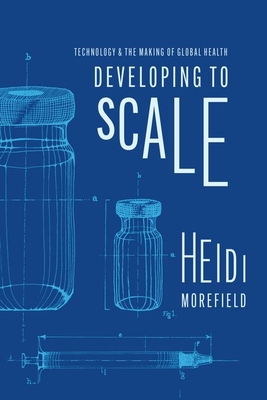
Developing to Scale: Technology and the Making of Global Health
| AUTHOR | Morefield, Heidi |
| PUBLISHER | University of Chicago Press (10/24/2023) |
| PRODUCT TYPE | Hardcover (Hardcover) |
Description
The first critical book on "appropriate technology," Developing to Scale shows how global health came to be understood as a problem to be solved with the right technical interventions. In 1973, economist E. F. Schumacher published Small Is Beautiful, which introduced a mainstream audience to his theory of "appropriate technology" the belief that international development projects in the Global South were most sustainable when they were small-scale, decentralized, and balanced between the traditional and the modern. His theory gained widespread appeal, as cuts to the foreign aid budget, the national interests of nations seeking greater independence, postcolonial activism, and the rise of the United States' tech sector drove stakeholders across public and private institutions toward cheaper tools. In the ensuing decades, US foreign assistance shifted away from massive modernization projects, such as water treatment facilities, toward point-of-use technologies like village water pumps and oral rehydration salts. This transition toward the small scale had massive implications for the practice of global health. Developing to Scale tells the history of appropriate technology in international health and development, relating the people, organizations, and events that shaped this consequential idea. Heidi Morefield examines how certain technologies have been defined as more or less "appropriate" for the Global South based on assumptions about gender, race, culture, and environment. Her study shows appropriate technology to be malleable, as different constituencies interpreted its ideas according to their own needs. She reveals how policymakers wielded this tool to both constrain aid to a scale that did not threaten Western interests and to scale the practice of global health through the development and distribution of technical interventions.
Show More
Product Format
Product Details
ISBN-13:
9780226828619
ISBN-10:
0226828611
Binding:
Hardback or Cased Book (Sewn)
Content Language:
English
More Product Details
Page Count:
232
Carton Quantity:
26
Product Dimensions:
6.00 x 0.63 x 9.00 inches
Weight:
1.09 pound(s)
Feature Codes:
Bibliography,
Index
Country of Origin:
US
Subject Information
BISAC Categories
Medical | History
Medical | History
Medical | Public Policy - Health Care
Dewey Decimal:
362.102
Library of Congress Control Number:
2023003657
Descriptions, Reviews, Etc.
publisher marketing
The first critical book on "appropriate technology," Developing to Scale shows how global health came to be understood as a problem to be solved with the right technical interventions. In 1973, economist E. F. Schumacher published Small Is Beautiful, which introduced a mainstream audience to his theory of "appropriate technology" the belief that international development projects in the Global South were most sustainable when they were small-scale, decentralized, and balanced between the traditional and the modern. His theory gained widespread appeal, as cuts to the foreign aid budget, the national interests of nations seeking greater independence, postcolonial activism, and the rise of the United States' tech sector drove stakeholders across public and private institutions toward cheaper tools. In the ensuing decades, US foreign assistance shifted away from massive modernization projects, such as water treatment facilities, toward point-of-use technologies like village water pumps and oral rehydration salts. This transition toward the small scale had massive implications for the practice of global health. Developing to Scale tells the history of appropriate technology in international health and development, relating the people, organizations, and events that shaped this consequential idea. Heidi Morefield examines how certain technologies have been defined as more or less "appropriate" for the Global South based on assumptions about gender, race, culture, and environment. Her study shows appropriate technology to be malleable, as different constituencies interpreted its ideas according to their own needs. She reveals how policymakers wielded this tool to both constrain aid to a scale that did not threaten Western interests and to scale the practice of global health through the development and distribution of technical interventions.
Show More
Your Price
$98.01