
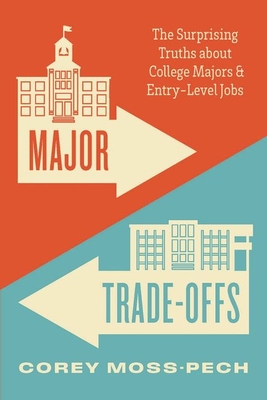
Major Trade-Offs: The Surprising Truths about College Majors and Entry-Level Jobs
| AUTHOR | Moss-Pech, Corey |
| PUBLISHER | University of Chicago Press (05/06/2025) |
| PRODUCT TYPE | Hardcover (Hardcover) |
Description
An eye-opening look at the relationship between students' majors and their entry-level jobs. Humanities majors are used to answering the question, "So, what are you going to do with that degree?" The common misconception is that students in humanities programs don't learn any useful skills for the real world. In Major Trade-Offs, sociologist Corey Moss-Pech argues that not only do humanities majors learn real-world skills, but they actually use them when they graduate. Despite this discrepancy, graduates with so-called practical degrees like business and engineering are much more likely to find employment, and they earn higher salaries. Why do we belittle a liberal arts education despite the valuable skills that students acquire during their studies? Major Trade-Offs addresses this question by following students from different majors as they enter the workforce. To understand the relationship between majors and entry-level jobs, Moss-Pech conducted nearly 200 interviews with roughly ninety students from four majors at a large Midwestern university: engineering, business, English, and communications. He follows these students through their senior years, chronicling their internships and the support their universities provide in helping them pursue their career paths. He found that graduates from practical majors entered the labor market successfully, typically through structured internship programs. However, many ended up in entry-level jobs that, while well-paid, were largely clerical and didn't necessarily require a degree to perform. On the other hand, liberal arts majors rarely accessed structured internships and were largely left to carve out their own paths, but did use their degree skills once they secured a job. These results challenge popular myths about the "marketability" of these different majors and offer a new vision for the future of higher education. Liberal arts skills are essential in the labor market, and yet educators and policymakers still push resources into the practical arts, perpetuating the myth that those majors are more valuable while depriving students of a well-rounded education and leaving them no better prepared for the workforce than liberal arts students. Of interest to students, educators, and employers, Major Trade-Offs calls on colleges and universities to advocate for liberal arts majors, leveling the playing field for students as they plan for entry-level work.
Show More
Product Format
Product Details
ISBN-13:
9780226840208
ISBN-10:
0226840204
Binding:
Hardback or Cased Book (Sewn)
Content Language:
English
More Product Details
Page Count:
224
Carton Quantity:
26
Product Dimensions:
6.00 x 0.63 x 9.00 inches
Weight:
1.04 pound(s)
Feature Codes:
Bibliography,
Index,
Price on Product,
Illustrated
Country of Origin:
US
Subject Information
BISAC Categories
Education | Schools - Levels - Higher
Education | Philosophy, Theory & Social Aspects
Education | Sociology - General
Dewey Decimal:
331.114
Library of Congress Control Number:
2024044558
Descriptions, Reviews, Etc.
publisher marketing
An eye-opening look at the relationship between students' majors and their entry-level jobs. Humanities majors are used to answering the question, "So, what are you going to do with that degree?" The common misconception is that students in humanities programs don't learn any useful skills for the real world. In Major Trade-Offs, sociologist Corey Moss-Pech argues that not only do humanities majors learn real-world skills, but they actually use them when they graduate. Despite this discrepancy, graduates with so-called practical degrees like business and engineering are much more likely to find employment, and they earn higher salaries. Why do we belittle a liberal arts education despite the valuable skills that students acquire during their studies? Major Trade-Offs addresses this question by following students from different majors as they enter the workforce. To understand the relationship between majors and entry-level jobs, Moss-Pech conducted nearly 200 interviews with roughly ninety students from four majors at a large Midwestern university: engineering, business, English, and communications. He follows these students through their senior years, chronicling their internships and the support their universities provide in helping them pursue their career paths. He found that graduates from practical majors entered the labor market successfully, typically through structured internship programs. However, many ended up in entry-level jobs that, while well-paid, were largely clerical and didn't necessarily require a degree to perform. On the other hand, liberal arts majors rarely accessed structured internships and were largely left to carve out their own paths, but did use their degree skills once they secured a job. These results challenge popular myths about the "marketability" of these different majors and offer a new vision for the future of higher education. Liberal arts skills are essential in the labor market, and yet educators and policymakers still push resources into the practical arts, perpetuating the myth that those majors are more valuable while depriving students of a well-rounded education and leaving them no better prepared for the workforce than liberal arts students. Of interest to students, educators, and employers, Major Trade-Offs calls on colleges and universities to advocate for liberal arts majors, leveling the playing field for students as they plan for entry-level work.
Show More
Your Price
$113.85