
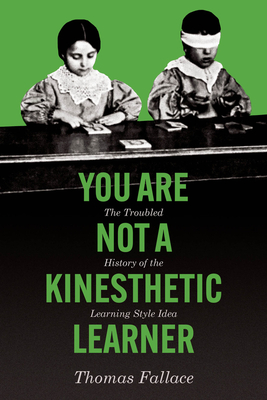
You Are Not a Kinesthetic Learner: The Troubled History of the Learning Style Idea
| AUTHOR | Fallace, Thomas |
| PUBLISHER | University of Chicago Press (05/14/2025) |
| PRODUCT TYPE | Paperback (Paperback) |
Description
A compelling history of the learning style concept and how it was shaped by shifting ideas in psychology, anthropology, and education. The widely embraced notion that we all process information in one of three distinct modes--visual, auditory, or kinesthetic--has informed educational practices for decades. In recent years, however, numerous studies have questioned the effectiveness of aligning instruction with the alleged learning styles of individual students. So, why is it still commonplace in the literature on beneficial teaching at all levels of education? In You Are Not a Kinesthetic Learner: The Troubled History of a Dangerous Idea, historian Thomas Fallace traces the origins, evolution, and history of the learning style idea, demonstrating its relationship to a legacy of unequal education for children of color. Fallace argues that the research supporting the learning style idea was problematic from its inception in the 1910s and that it was used to label and justify a diminished curriculum for many Black and Latine students, whose cultural differences were perceived as weaknesses. In recent years, numerous empirical studies have not found the approach to be effective. This fascinating history clearly shows the danger of sorting and labeling students with permanent style identities and makes a strong case for removing learning styles as the basis for any educators' instructional toolkit. The first book-length history of learning styles, You Are Not a Kinesthetic Learner encourages us all to consider the research, be open to future developments and updates, and question even our most intuitive assumptions.
Show More
Product Format
Product Details
ISBN-13:
9780226841380
ISBN-10:
0226841383
Binding:
Paperback or Softback (Trade Paperback (Us))
Content Language:
English
More Product Details
Page Count:
240
Carton Quantity:
56
Product Dimensions:
6.00 x 0.60 x 8.90 inches
Weight:
0.65 pound(s)
Feature Codes:
Bibliography,
Index,
Price on Product
Country of Origin:
US
Subject Information
BISAC Categories
Education | History
Education | Educational Policy & Reform
Education | United States - 20th Century
Dewey Decimal:
370.152
Library of Congress Control Number:
2024043186
Descriptions, Reviews, Etc.
publisher marketing
A compelling history of the learning style concept and how it was shaped by shifting ideas in psychology, anthropology, and education. The widely embraced notion that we all process information in one of three distinct modes--visual, auditory, or kinesthetic--has informed educational practices for decades. In recent years, however, numerous studies have questioned the effectiveness of aligning instruction with the alleged learning styles of individual students. So, why is it still commonplace in the literature on beneficial teaching at all levels of education? In You Are Not a Kinesthetic Learner: The Troubled History of a Dangerous Idea, historian Thomas Fallace traces the origins, evolution, and history of the learning style idea, demonstrating its relationship to a legacy of unequal education for children of color. Fallace argues that the research supporting the learning style idea was problematic from its inception in the 1910s and that it was used to label and justify a diminished curriculum for many Black and Latine students, whose cultural differences were perceived as weaknesses. In recent years, numerous empirical studies have not found the approach to be effective. This fascinating history clearly shows the danger of sorting and labeling students with permanent style identities and makes a strong case for removing learning styles as the basis for any educators' instructional toolkit. The first book-length history of learning styles, You Are Not a Kinesthetic Learner encourages us all to consider the research, be open to future developments and updates, and question even our most intuitive assumptions.
Show More
List Price $27.50
Your Price
$27.22