
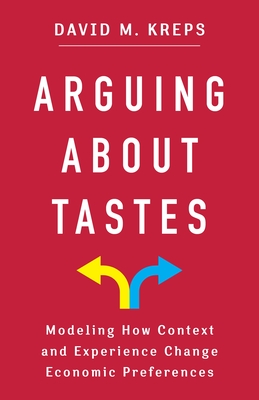
Arguing about Tastes: Modeling How Context and Experience Change Economic Preferences
| AUTHOR | Casella, Alessandra; Stiglitz, Joseph E.; Kreps, David et al. |
| PUBLISHER | Columbia University Press (11/28/2023) |
| PRODUCT TYPE | Paperback (Paperback) |
Mainstream economics considers individual preferences to be fixed and unchanging. Although psychologists and other social scientists explore how tastes are formed, influenced, and evolve, it is not considered "proper" in orthodox economics to do so. Arguing About Tastes makes the case that economists should abandon the principle that preferences are fixed and instead incorporate into their work how context and experience shape individual tastes.
David M. Kreps argues that the discipline must account for dynamic personal tastes when it comes to understanding social exchange, emphasizing human resource management and on-the-job behavior. He develops formal models that illustrate the power of intrinsic motivation and show why applying extrinsic incentives can be counterproductive. Kreps weighs the advantages and disadvantages of the principle de gustibus non est disputandum: there is no arguing about tastes. He calls for a new era of economics in which preferences are taken into account--and not for granted. Arguing About Tastes concludes with responses by the distinguished economists Alessandra Casella and Joseph E. Stiglitz and a final reply by Kreps.Mainstream economics considers individual preferences to be fixed and unchanging. Although psychologists and other social scientists explore how tastes are formed, influenced, and evolve, it is not considered "proper" in orthodox economics to do so. Arguing About Tastes makes the case that economists should abandon the principle that preferences are fixed and instead incorporate into their work how context and experience shape individual tastes.
David M. Kreps argues that the discipline must account for dynamic personal tastes when it comes to understanding social exchange, emphasizing human resource management and on-the-job behavior. He develops formal models that illustrate the power of intrinsic motivation and show why applying extrinsic incentives can be counterproductive. Kreps weighs the advantages and disadvantages of the principle de gustibus non est disputandum: there is no arguing about tastes. He calls for a new era of economics in which preferences are taken into account--and not for granted. Arguing About Tastes concludes with responses by the distinguished economists Alessandra Casella and Joseph E. Stiglitz and a final reply by Kreps.