
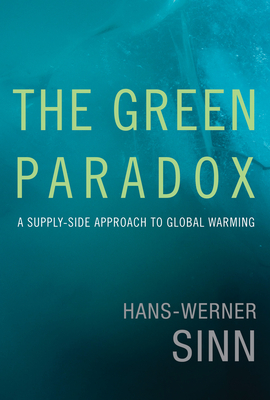
The Green Paradox: A Supply-Side Approach to Global Warming
| AUTHOR | Sinn, Hans-Werner; Sinn, Hans-Werner |
| PUBLISHER | MIT Press (02/03/2012) |
| PRODUCT TYPE | Hardcover (Hardcover) |
The Earth is getting warmer. Yet, as Hans-Werner Sinn points out in this provocative book, the dominant policy approach--which aims to curb consumption of fossil energy--has been ineffective. Despite policy makers' efforts to promote alternative energy, impose emission controls on cars, and enforce tough energy-efficiency standards for buildings, the relentlessly rising curve of CO2 output does not show the slightest downward turn. Some proposed solutions are downright harmful: cultivating crops to make biofuels not only contributes to global warming but also uses resources that should be devoted to feeding the world's hungry. In The Green Paradox, Sinn proposes a new, more pragmatic approach based not on regulating the demand for fossil fuels but on controlling the supply.
The owners of carbon resources, Sinn explains, are pre-empting future regulation by accelerating the production of fossil energy while they can. This is the "Green Paradox" expected future reduction in carbon consumption has the effect of accelerating climate change. Sinn suggests a supply-side solution: inducing the owners of carbon resources to leave more of their wealth underground. He proposes the swift introduction of a "Super-Kyoto" system--gathering all consumer countries into a cartel by means of a worldwide, coordinated cap-and-trade system supported by the levying of source taxes on capital income--to spoil the resource owners' appetite for financial assets.
Only if we can shift our focus from local demand to worldwide supply policies for reducing carbon emissions, Sinn argues, will we have a chance of staving off climate disaster.
The Earth is getting warmer. Yet, as Hans-Werner Sinn points out in this provocative book, the dominant policy approach--which aims to curb consumption of fossil energy--has been ineffective. Despite policy makers' efforts to promote alternative energy, impose emission controls on cars, and enforce tough energy-efficiency standards for buildings, the relentlessly rising curve of CO2 output does not show the slightest downward turn. Some proposed solutions are downright harmful: cultivating crops to make biofuels not only contributes to global warming but also uses resources that should be devoted to feeding the world's hungry. In The Green Paradox, Sinn proposes a new, more pragmatic approach based not on regulating the demand for fossil fuels but on controlling the supply.
The owners of carbon resources, Sinn explains, are pre-empting future regulation by accelerating the production of fossil energy while they can. This is the "Green Paradox" expected future reduction in carbon consumption has the effect of accelerating climate change. Sinn suggests a supply-side solution: inducing the owners of carbon resources to leave more of their wealth underground. He proposes the swift introduction of a "Super-Kyoto" system--gathering all consumer countries into a cartel by means of a worldwide, coordinated cap-and-trade system supported by the levying of source taxes on capital income--to spoil the resource owners' appetite for financial assets.
Only if we can shift our focus from local demand to worldwide supply policies for reducing carbon emissions, Sinn argues, will we have a chance of staving off climate disaster.