
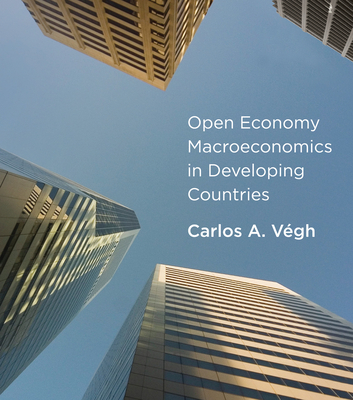
Open Economy Macroeconomics in Developing Countries
| AUTHOR | Vegh, Carlos A.; Vgh, Carlos A.; Vegh, Carlos A. |
| PUBLISHER | MIT Press (08/30/2013) |
| PRODUCT TYPE | Hardcover (Hardcover) |
This rigorous and comprehensive textbook develops a basic small open economy model and shows how it can be extended to answer many important macroeconomic questions that arise in emerging markets and developing economies, particularly those regarding monetary, fiscal, and exchange rate issues. Eschewing the complex calibrated models on which the field of international finance increasingly relies, the book teaches the reader how to think in terms of simple models and grasp the fundamentals of open economy macroeconomics.
After analyzing the standard intertemporal small open economy model, the book introduces frictions such as imperfect capital markets, intertemporal distortions, and nontradable goods, into the basic model in order to shed light on the economy's response to different shocks. The book then introduces money into the model to analyze the real effects of monetary and exchange rate policy. It then applies these theoretical tools to a variety of important macroeconomic issues relevant to developing countries (and, in a world of continuing financial crisis, to industrial countries as well), including the use of a nominal interest rate as a main policy instrument, the relative merits of flexible and predetermined exchange rate regimes, and the targeting of "real anchors." Finally, the book analyzes in detail specific topics such as inflation stabilization, "dollarization," balance of payments crises, and, inspired by recent events, financial crises. Each chapter includes boxes with relevant empirical evidence and ends with exercises. The book is suitable for use in graduate courses in development economics, international finance, and macroeconomics.
This rigorous and comprehensive textbook develops a basic small open economy model and shows how it can be extended to answer many important macroeconomic questions that arise in emerging markets and developing economies, particularly those regarding monetary, fiscal, and exchange rate issues. Eschewing the complex calibrated models on which the field of international finance increasingly relies, the book teaches the reader how to think in terms of simple models and grasp the fundamentals of open economy macroeconomics.
After analyzing the standard intertemporal small open economy model, the book introduces frictions such as imperfect capital markets, intertemporal distortions, and nontradable goods, into the basic model in order to shed light on the economy's response to different shocks. The book then introduces money into the model to analyze the real effects of monetary and exchange rate policy. It then applies these theoretical tools to a variety of important macroeconomic issues relevant to developing countries (and, in a world of continuing financial crisis, to industrial countries as well), including the use of a nominal interest rate as a main policy instrument, the relative merits of flexible and predetermined exchange rate regimes, and the targeting of "real anchors." Finally, the book analyzes in detail specific topics such as inflation stabilization, "dollarization," balance of payments crises, and, inspired by recent events, financial crises. Each chapter includes boxes with relevant empirical evidence and ends with exercises. The book is suitable for use in graduate courses in development economics, international finance, and macroeconomics.