
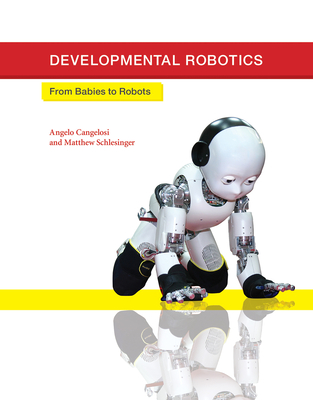
Developmental Robotics: From Babies to Robots
| AUTHOR | Smith, Linda B.; Schlesinger, Matthew; Schlesinger, Matthew et al. |
| PUBLISHER | MIT Press (01/23/2015) |
| PRODUCT TYPE | Hardcover (Hardcover) |
Developmental robotics is a collaborative and interdisciplinary approach to robotics that is directly inspired by the developmental principles and mechanisms observed in children's cognitive development. It builds on the idea that the robot, using a set of intrinsic developmental principles regulating the real-time interaction of its body, brain, and environment, can autonomously acquire an increasingly complex set of sensorimotor and mental capabilities. This volume, drawing on insights from psychology, computer science, linguistics, neuroscience, and robotics, offers the first comprehensive overview of a rapidly growing field.
After providing some essential background information on robotics and developmental psychology, the book looks in detail at how developmental robotics models and experiments have attempted to realize a range of behavioral and cognitive capabilities. The examples in these chapters were chosen because of their direct correspondence with specific issues in child psychology research; each chapter begins with a concise and accessible overview of relevant empirical and theoretical findings in developmental psychology. The chapters cover intrinsic motivation and curiosity; motor development, examining both manipulation and locomotion; perceptual development, including face recognition and perception of space; social learning, emphasizing such phenomena as joint attention and cooperation; language, from phonetic babbling to syntactic processing; and abstract knowledge, including models of number learning and reasoning strategies. Boxed text offers technical and methodological details for both psychology and robotics experiments.
Developmental robotics is a collaborative and interdisciplinary approach to robotics that is directly inspired by the developmental principles and mechanisms observed in children's cognitive development. It builds on the idea that the robot, using a set of intrinsic developmental principles regulating the real-time interaction of its body, brain, and environment, can autonomously acquire an increasingly complex set of sensorimotor and mental capabilities. This volume, drawing on insights from psychology, computer science, linguistics, neuroscience, and robotics, offers the first comprehensive overview of a rapidly growing field.
After providing some essential background information on robotics and developmental psychology, the book looks in detail at how developmental robotics models and experiments have attempted to realize a range of behavioral and cognitive capabilities. The examples in these chapters were chosen because of their direct correspondence with specific issues in child psychology research; each chapter begins with a concise and accessible overview of relevant empirical and theoretical findings in developmental psychology. The chapters cover intrinsic motivation and curiosity; motor development, examining both manipulation and locomotion; perceptual development, including face recognition and perception of space; social learning, emphasizing such phenomena as joint attention and cooperation; language, from phonetic babbling to syntactic processing; and abstract knowledge, including models of number learning and reasoning strategies. Boxed text offers technical and methodological details for both psychology and robotics experiments.